‘At home’ in Indy parish, Eritreans and Ethiopians also find joy in native Ge’ez rite
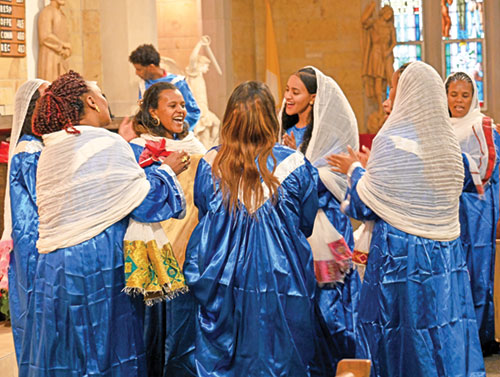
After a Mass celebrating Christmas on Jan. 10 in St. Michael the Archangel Church in Indianapolis, women of the Eritrean and Ethiopian Catholic community choir radiate joy as they perform a traditional shebshebo dance rejoicing at the birth of Christ. According to the Ge’ez rite calendar used by the Eritrean and Ethiopian Churches, Christmas is celebrated on Dec. 29, which is Jan. 7 on the Gregorian calendar used by most of the world. (Photo by Natalie Hoefer)
By Natalie Hoefer
The atmosphere in St. Michael the Archangel Church in Indianapolis was one of unrestrained joy during a special Mass on Jan. 10.
Festively-dressed Catholics greeted one another with radiant smiles. Those smiles also beamed during traditional dances and songs—by men before the Mass and by women afterward—accompanied by singing, clapping and the deep beats of a large drum.
It was a true celebration. And why shouldn’t it be? The Mass, after all, was celebrating the Jan. 7 feast of Christmas. (See a photo gallery from the event)
No, not the Epiphany but Christmas— according to the Catholic Ge’ez rite (pronounced like “geese” but with a z) used by the Eritrean and Ethiopian Catholic Churches. Eritrea and Ethiopia are neighboring counties in northeastern Africa.
“In the Ge’ez rite, everything is different—the Mass, the calendar,” says Samson Gebray, a native of Ethiopia. “We are eight days behind [the Gregorian calendar used by most of the world], our new year starts in September, and for us it’s 2018. So, if you want to feel young, join the Ge’ez rite,” he adds with a laugh.
Gebray, his wife and their four children are among the roughly 50 Eritrean and Ethiopian families who call St. Michael the Archangel Parish their faith home.
“We go to Mass every Sunday, we receive the sacraments, we contribute to the [parish], our kids go to school here,” says Gebray. “The parishioners and [parish pastor] Father [John] Kamwendo have all been so welcoming, so helpful.”
But each year, the Eritrean and Ethiopian Catholic community invites a priest to celebrate the Ge’ez Mass for three feasts according to the rite’s calendar—Christmas, Easter and a day in July honoring the mercy of the Blessed Mother.
Gebray’s eyes light up when he talks about those Masses.
“We wait so eagerly for getting at least those three main, important days in our rite,” he says.
‘Mass hits deeper in your own language’
That rite uses the Ge’ez language. Gebray likens it to Masses celebrated in Latin: “Nobody speaks Ge’ez except in the Mass.”
Like anyone worshiping at Mass in an unfamiliar language, Gebray admits when he came to the U.S., “At first, every Sunday I didn’t know what they were saying.”
Language is not the only difference between the Roman and Ge’ez rite Mass. The latter follows a different order, includes more symbolic gestures and is longer. (Related: Worshiping in the Ge’ez rite)
“It was so short!” Gebray recalls of his first Mass in the U.S. “When it was over, I thought, ‘Are we done already?’ At home in Ethiopia, Mass was two hours every Sunday. We get used to the Mass here, but your heart and worship feel empty at first.”
Even Rossa Zerezgi, a native of Eritrea who arrived in the U.S. 12 years ago at the age of 7, says she “vividly” remembers worshiping in her home country “because our Mass is so lively. There would be a lot of music.”
While she speaks mostly in English now, “When I hear the Mass in Ge’ez, I feel different,” says Zerezgi, a student at Indiana University in Bloomington. “The Mass hits deeper when you hear it in your own language.”
‘We are grateful for this parish’
Making the three yearly Ge’ez rite Masses happen is a labor of love—starting with finding a priest.
“We have to search around the states,” says Gebray. “They mostly come from Washington and Atlanta, and also from Columbus, Ohio—there is a large Ge’ez community there.”
The celebrant for the Christmas Mass this year, Vincentian Father Haile Suba, is a native of Eritrea working on a master’s degree at St. John’s University in Queens, N.Y.
As with all of their guest priests, the Eritrean and Ethiopian families paid Father Haile’s travel and housing costs for his trip to Indianapolis.
But the search and cost are nothing compared to the joy of celebrating Mass in the language and form so deeply rooted in their hearts.
“We bring our music, we have a big drum,” says Gebray. “We do special dances and chant and sing in the church before and after the Mass. Some join from all over Indiana and even from Kentucky.
“To be honest, I wish we could do this every Sunday. It makes a big difference to worship in the way you were raised.”
Zerezgi agrees.
“It’s beautiful to see my parents really fully immerse themselves” in the Ge’ez Masses, she says. “I love seeing everybody get together on these holidays when we can get our own priest. It’s beautiful to be able to express our faith in that way.”
There are other unique expressions of the Ge’ez rite beyond the Mass.
“On Good Friday [according to the Ge’ez calendar], we fast all day and stay in the church from 3 a.m. until 5 p.m. praying and chanting,” Gebray explains.
“The people at St. Michael work with us so we don’t conflict with their schedule. They’re very cooperative.”
But there are other aspects of the Ge’ez rite that are more difficult to accommodate.
“When someone dies, we come together and mourn for four days,” says Gebray. In an active parish like St. Michael, it’s simply not possible to dedicate space “to do funerals like we do in Ge’ez,” he notes.
“We hope to find a place on the west side or downtown that we could rent or buy to use for our funerals and other rituals.
“Then, if the community grows, the dream would be to have our own parish.”
That dream is in no way a negative reflection on St. Michael, Gebray assures.
“We are grateful for this parish, the people and Father Kamwendo,” he says on behalf of the Eritrean and Ethiopian Catholic community. “They give us that sense of belonging. We feel at home here.”
(For information on when the Ge’ez rite Mass is celebrated at St. Michael the Archangel Church, contact Samson Gebray at akbe-g@yahoo.com.) †
Related: ‘Cultures in Communion’ series highlights Church’s cultural diversity in archdiocese