Sacred Heart second-graders’ project helps them ‘really understand the Eucharist’
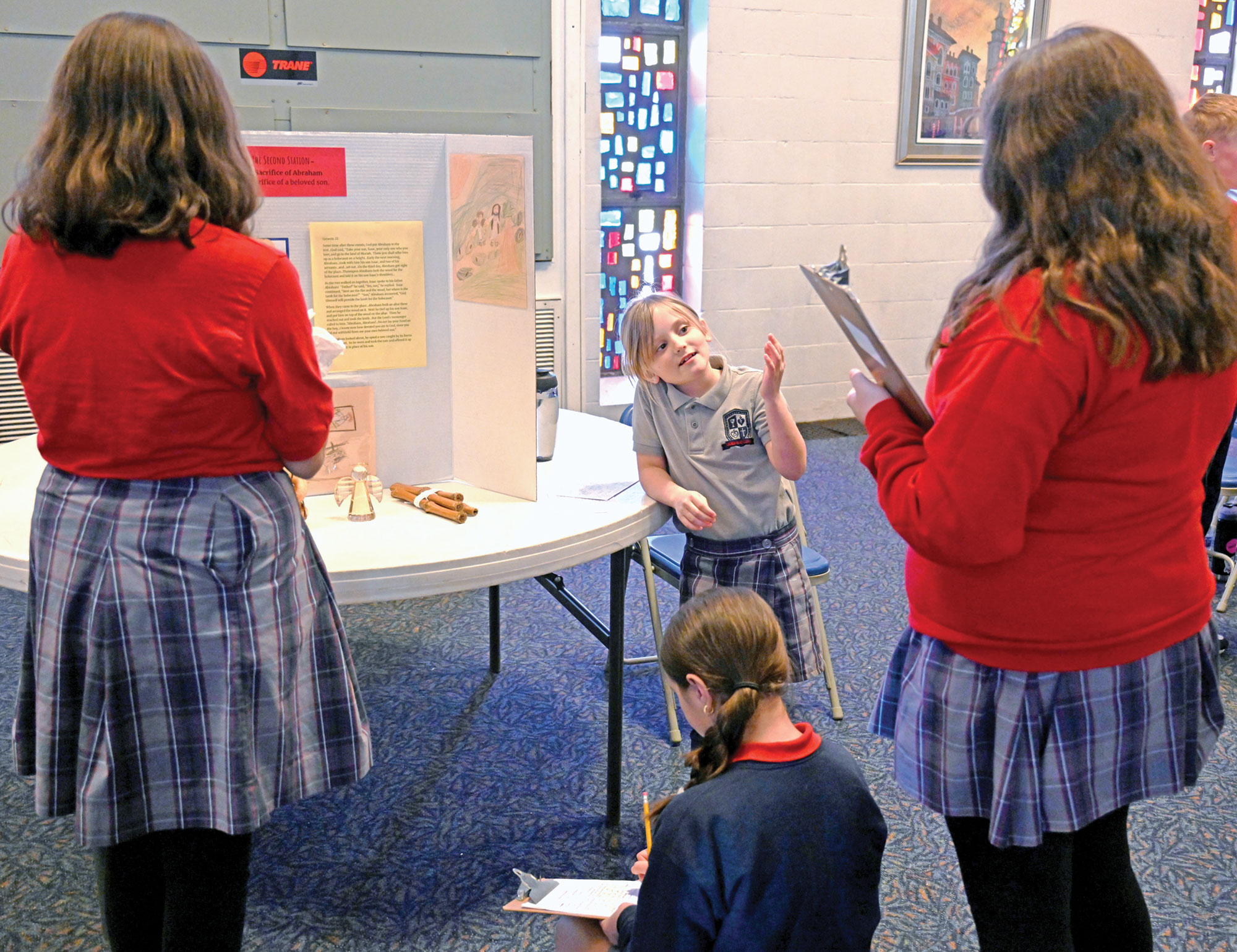
Standing at center, Eisley Smith, a second-grade student at Sacred Heart School in Jeffersonville, explains the Second Station of the Eucharist to other students in the parish’s activity center on March 12 during a Stations of the Eucharist exhibit she and her classmates created and presented as part of a project preparing them to receive their first Communion. (Photo by Natalie Hoefer)
By Natalie Hoefer
JEFFERSONVILLE—Petite and poised, Zoey Evanczyk greets a group of youths to her table, excited to share with them about her favorite of the 14 Stations.
“Welcome to the Fourteenth Station,” she begins. “My station is about the Wedding Feast of the Lamb.”
She didn’t misunderstand the station. Zoey and her
second-grade classmates of Sacred Heart School in Jeffersonville were presenting an exhibit on the 14 Stations of the Eucharist in the parish’s activity center on March 12 for the other grades and all members of the parish. The project helps prepare the students for their first Communion.
After learning about the stations and creating their presentations, the children “really understand the Eucharist—I mean they really understand,” says Debby Townsend, the school’s second-grade teacher. “I think kids can understand and do more than we think.”
Father Adam Ahern, pastor of Most Sacred Heart of Jesus and St. Augustine parishes, both in Jeffersonville, agrees “100%.”
“I love this event,” now in its third year, he says. “All the kids [in the school] who are making their first Communion, I think they understand the topic a little bit better. [The exhibit is] another avenue for them to understand that the Eucharist is Jesus.”
Townsend might have come up with the idea of using the Stations of the Eucharist as catechesis for first Communicants. But the actual stations and concept of the exhibit?
“I borrowed them,” she admits.
‘Bible detectives’ researching the Eucharist
It was the summer of 2023 when Townsend heard about an exhibit on the 14 Stations of the Eucharist on display as part of All Saints Parish’s picnics at each of its four campuses in Dearborn County.
“I was just getting ready to start teaching second grade” at Sacred Heart, which included preparing students for first Communion, she says. “I thought maybe [the exhibit] could be something I could do with the second-graders, so I went.”
The 14 stations were created by Father Jonathan Meyer, who serves in the four parishes of Dearborn County. In a booklet explaining the stations, he notes they were inspired by the 12 Stations of the Holy Eucharist designed by the Poor Clares of Perpetual Adoration of Our Lady of the Angels Monastery in Hanceville, Ala.
The stations span events throughout the Bible. From the sacrifice of Abel in Genesis to the wedding feast of the lamb in Revelations, each reveals God’s plan for the gift of the Eucharist.
In the middle, the Seventh Station presents the birth of Christ.
“I decided to try out the Christmas one with the kids,” says Townsend. “It talks about how Bethlehem means ‘house of bread,’ and Jesus is the bread from heaven—and they got it. They totally understood.”
As preparation for the exhibit begins in February, she says she turns the students into “Bible detectives.”
“For each station, we read the Scripture passage together,” Townsend explains. “Then I’ll ask, ‘What from that [reading] reminds you of Mass?’ Then they all write down what they think, and we talk about it.”
Before long, the children start recognizing words and phrases in the liturgy that they encountered in the passages for the stations.
“We’ll be reading the Scriptures for the stations, and they’ll say, ‘Oh! That’s the thing we say in Mass!’ ” says Townsend. “Like, when Father holds up the Eucharist and says, ‘Behold the Lamb of God,’ they’re like, ‘That’s what John the Baptist said!’
“Or I’ll ask, ‘Why is Jesus the lamb? Because he’s fluffy?’ And they all say, ‘No! Because he’s the sacrifice!’ ”
By the time of the exhibit, the students “really get” the Eucharist,” says Townsend. “I think they understand it better than most adults do.”
In fact, she adds, parents of the students and adults who visit the exhibit have made comments to her like, “I’ve learned things from my kid that I didn’t know,” “that never made sense to me before” and “I never heard that before.”
Like a prediction, those very words are heard at Eli Wright’s presentation of the Thirteenth Station.
‘I’m really, really, really excited!’
A group of students and adults listen as he recounts from the Gospel of Luke the story of Jesus joining two disciples traveling to Emmaus the day after the crucifixion.
“But they didn’t know it was Jesus until he blessed and broke the bread at supper,” says Eli.
When he adds, “That makes [Emmaus] the second Mass,” an older woman in the group turns to another in surprise, saying, “I never knew that.”
“The priest breaks the bread at every Mass just like Jesus did,” Eli concludes. “So, we can recognize Jesus in the breaking of the bread at Mass like the [two] disciples.”
Father Ahern appreciates how the stations are grounded in Scripture.
“Everything relates back to the Old Testament and New Testament,” he says. “It just helps [the second-graders] see the connections the Eucharist has across human history.”
Eisley Smith makes those connections clear in her presentation on the Second Station, the sacrifice of Isaac by Abraham in the Book of Genesis. Like a well-versed scholar, she ticks them off one by one.
“So, Isaac is like Jesus,” she says. “Isaac is Abraham’s only beloved son; Jesus is God’s only beloved son. Isaac carried the wood for the sacrifice up the mountain; Jesus carried the wood of the cross up Calvary. Isaac will be the sacrifice; Jesus will be the sacrifice. Isaac walked three days to get to the mountain; Jesus spent three days in the tomb.
“Now, Abraham said that God will provide a lamb for the sacrifice,” Eisley continues, adding emphasis to drive home her points. “But he didn’t provide a lamb for the sacrifice—he provided a ram. The ram got stuck in thorns, and Jesus wore a crown of thorns. Later, when Jesus died on the cross, that’s when God provided the lamb—Jesus is the Lamb of God.”
The Fourteenth Station continues the “lamb” theme as Zoey shares about the wedding feast of the Lamb.
“For this is the wedding day of the Lamb, his bride has made herself ready,” she reads from Revelation 19:7-8. “She has been given a dress to wear, made of the finest linen, brilliant white. Blessed are those who have been called to the wedding feast of the Lamb.”
Zoey points to a statue on her table of a bride adorned in white—just like the dress she will wear in a few weeks.
“I wanted to present this station because it’s all about Communion, and I’ll be making my first Communion” on May 3, she shares with a broad smile. Six of her 16 classmates will join her. Three other second-graders received their first Communion and were also baptized and confirmed during the Easter Vigil Mass on April 4 at Most Sacred Heart of Jesus Church in Jeffersonville.
Zoey’s enthusiasm proves how the 14 Stations “personalize the Eucharist a whole lot more” for the second-graders making their first Communion, says Father Ahern. “It’s just another way for them to understand this teaching that we have: Jesus is the Eucharist.”
And Zoey understands—she really understands.
“I’m going to receive Jesus, and Jesus is going to be way closer to me than he used to be,” she gushes, her face lit with joy. “So I’m really, really, really excited!” †