‘Your best ability is availability’
Extended opportunities for confession reflect a renewed dedication to the sacrament
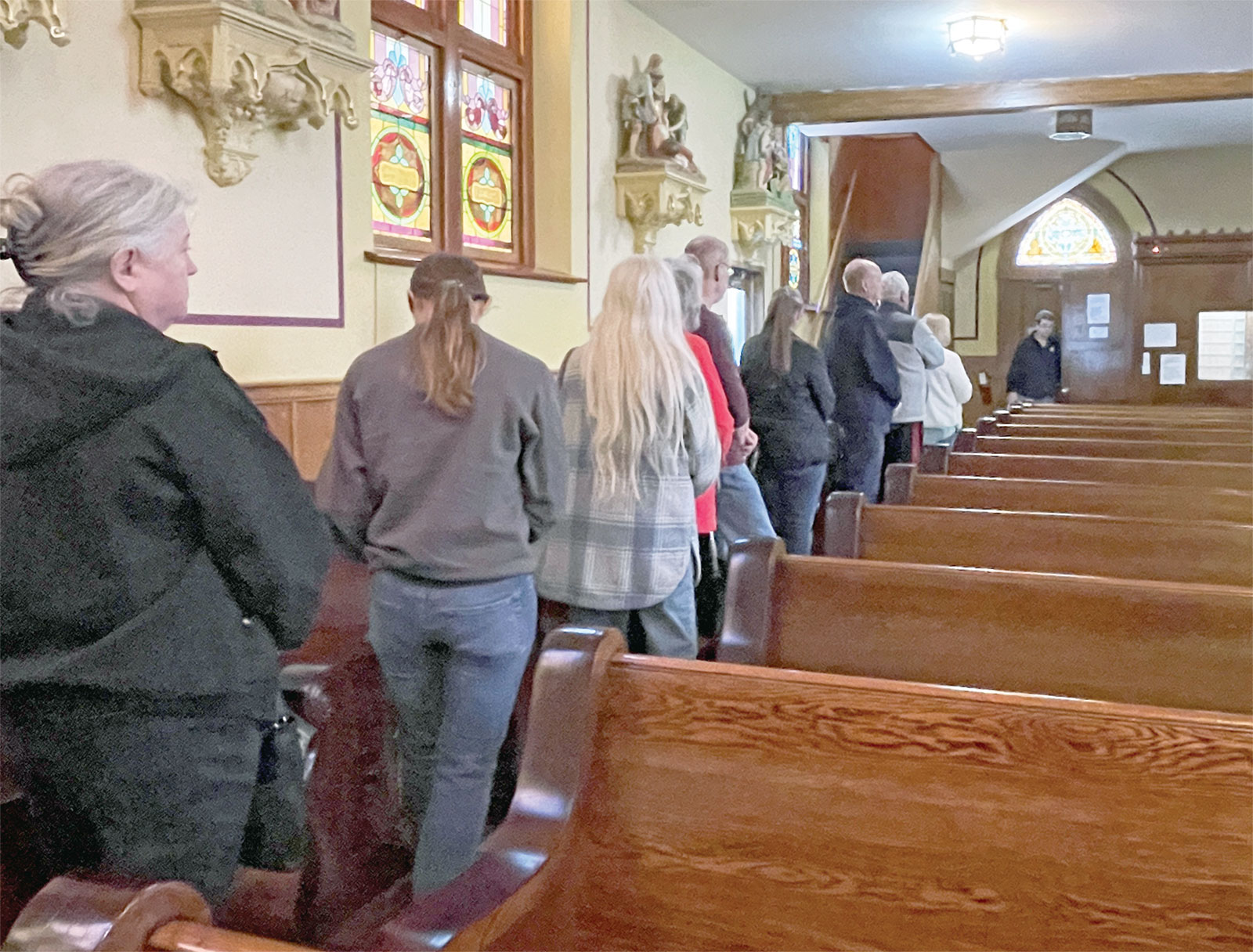
People stand in line for the sacrament of penance on Feb. 20 at St. Mary of the Immaculate Conception Church in Aurora, where the sacrament is made available from 9 a.m.-9 p.m. every third Friday of the month in an initiative called “12 Hours of Grace.” (Submitted photo)
By Sean Gallagher
Brad Macke is a busy man.
Being a husband and father of five daughters, ages 12 down to 7 months, and serving as the director of mission and a theology and math teacher at Fiat Classical Academy in Aurora, keep him hopping.
Finding time to go to confession, something that he seeks to do on a monthly basis, might be a challenge for him, given his hectic life. But, as a Catholic in Dearborn County, it’s actually pretty easy.
All Saints Parish, in the northern part of the county, offers the sacrament of penance from 9 a.m.-9 p.m. every first Friday of the month. Confession is also available during the same hours on every third Friday at St. Mary of the Immaculate Conception Parish in Auora along the Ohio River in the southern part of the county.
The initiative
is called “12 Hours of Grace,” and
it began more than a decade ago at
All Saints, where Macke and his family are parishioners. He said that it “removes a significant barrier” for him, his wife and their children who are old enough to take part regularly in the sacrament of reconciliation.
“As loved sinners, seeking to be holy, my family continuously needs to be forgiven and strengthened by the sacrament,” Macke said. “Obviously, it restores and deepens our relationship with the Lord. But it also helps us to love each other as we really desire to.
“Family life is hard, and we continue to offend and hurt each other. I find that returning to God’s mercy in the sacrament each month brings the joy of being forgiven, teaches us to forgive each other and brings freshness or newness in our relationships.”
Over the past several years, a number of parishes across central and southern Indiana have begun to offer the sacrament of penance for several hours at a time during Advent and Lent. There have been practical reasons behind some of these changes. At the same time, both priests and penitents have experienced spiritual benefits from celebrating the sacrament in this context. (Related: Several parishes offer extended hours to receive sacrament of penance)
Meeting people where they’re at
Father Eric Augenstein has observed the merits of this approach over several years. In fact, he may have gotten the ball rolling in the archdiocese by offering the sacrament of penance for several hours at a time.
He was pastor of Our Lady of Perpetual Help Parish in New Albany when it had its first “12 Hours of Grace” in Lent in 2008 and in some years thereafter. He’s continued the practice during Lent as pastor of Nativity of Our Lord Jesus Christ Parish in Indianapolis.
For him, it made the sacrament of reconciliation more easily available for his parishioners.
“Virtually everyone could find time in a 12-hour period if they want to go to confession,” Father Augenstein said.
Father Jonathan Meyer has found in offering the sacrament of penance for 12 hours twice a month that people most commonly go to confession in hours not connected to the celebration of Mass, either on weekdays or on weekends.
For several years as All Saints and
St. Mary of the Immaculate Conception have had the sacrament available for 12 hours, data has been collected about how many confessions are heard and the hours in which people are going to confession.
“The data actually speaks for itself,” said Father Meyer who, along with Father John Hollowell, serves in the four parishes of Dearborn County.
Over the past 12 years, the hours in which people come the most for the sacrament of reconciliation at All Saints are during the 1 p.m., 5p.m and 6 p.m. time slots. Since 2021, people come to St. Mary of the Immaculate Conception the most in the 11 a.m., 5 p.m. and 6 p.m. time slots.
“The most popular hours prove the fact that when we normally offer confession is not when people are actually fully available,” Father Meyer said. “The 12-hour model just meets people where they’re at.”
Father Augenstein and Father Todd Goodson, pastor of Our Lady of the Greenwood Parish in Greenwood, where 12 consecutive hours of confessions are offered during Advent and Lent, also noted that it has been easy for them to find priests serving in nearby parishes to commit to being in their faith communities’ confessional for a one-hour time slot when the sacrament is available over a long period of time.
For the most part, that’s not an option for Father Meyer and Father Hollowell in the parishes of Dearborn County.
Although they get assistance from some priests in the nearby Archdiocese of Cincinnati, these two priests will be in the confessional for several hours at a time on the first and third Fridays each month.
But those days are something that Father Meyer actually looks forward to.
“It’s almost like a retreat for me,” he said. “I’m not in the office. I’ll just stay in the rectory or be in the confessional. I actually look forward to it. It’s a beautiful, relaxed, calm day.”
Setting an example
While Father Meyer may see those two Fridays when he spends several hours in a confessional as a kind of retreat for himself, Macke recognizes that Father Meyer, Father Hollowell and the other priests who take time in the confessional are still making a sacrifice to make the sacrament of reconciliation readily available for the Catholics of Dearborn County.
It’s a sacrifice that encourages him in his own vocation.
“The priests who spend themselves in the confessional for hours inspire and challenge me to be more generous and sacrificial to my wife and daughters,” Macke said. “They set an example for how I’m called to be a father.”
At the same time, Father Meyer sees a good example in the many Catholics who put such a priority on the sacrament of reconciliation that they carve out time in their busy days to avail themselves of the sacrament when it’s offered during a 12-hour period.
“It’s formed my heart to really think of the penitent, like those who are showing up for confession at 8 o’clock at night,” he said. “That’s their only time. It’s what works for them. That moves my heart.”
Father Goodson sees blessings in people reaping the benefits of the sacrament of penance at Our Lady of the Greenwood, which is available there daily.
“It’s edifying to see people taking advantage of one of the sacraments of the Church, the one that reconciles them to God, to the Church and to the community,” he said.
In addition to offering the sacrament for 12 hours in one day during Lent, Father Goodson said that confession on Wednesday of Holy Week at his parish, just before the start of the Triduum, has also become something of a tradition.
When he first began to minister at Our Lady of the Greenwood in 2019, he said he was shocked when 85 people came for confession on Wednesday of Holy Week that year.
Now, he knows to plan for it.
“I try to get three or four priests to hear confessions,” Father Goodson said. “We’ll hear on that Wednesday before the Triduum up to 200 to 250 confessions.”
‘Your best ability is availability’
What Father Goodson has seen at
Our Lady of the Greenwood—and which he knows is happening to various degrees in other parishes across central and southern Indiana—is evidence of a renewal in the sacrament of reconciliation in the lives of many Catholics.
“There is some sort of movement of the Holy Spirit,” he said. “Confession opportunities are increasing. More people are availing themselves of the sacrament.”
The Spirit may also have been moving priests and penitents in the archdiocese to the offering of the sacrament of reconciliation over long periods through their participation in major Catholic events held in Indianapolis.
The National Catholic Youth Conference, the Fellowship of Catholic University Students’ SEEK conference and the National Eucharistic Congress all included having the sacrament of reconciliation available over several hours.
Father Augenstein said that this is “a major component” of such events held here.
“That’s not always the case in the parishes that people have come from when they go [to these events],” he said. “So, they take that experience back with them to their parishes.”
For Father Meyer, the data that has been collected in Dearborn County supports the view that a renewal in the sacrament of reconciliation is happening—at least in the parishes in which he ministers.
In 2014, an average of 89 people went to confession at All Saints on the days when the sacrament of penance was available over 12 hours. By 2025, that average had more than doubled, growing to 194.
The practice began in Aurora in 2021 when 96 people on average took part in the sacrament. Just four years later in 2025, the average had grown by more than 50% to 146.
“There were times [early on] when there weren’t people coming to confession,” Father Meyer said. “Now, when I go to 12 Hours [of Grace], I know I’m just going to be busy the entire time. It’s a different experience. The culture has clearly changed.”
Father Augenstein has witnessed the same change since he was ordained a priest in 2004.
“When I was first ordained, virtually every parish had confession on Saturday afternoon or by appointment, and that was it,” he said. “It was much more limited. It’s more available now.”
And in making it more available, Father Augenstein sees more people opening themselves to the gift of God’s mercy in the sacrament.
“As a Church and as priests, if we make ourselves available in the life of a parish, people will come,” he said.
And priests simply making themselves available to share God’s mercy in the sacrament of reconciliation is the biggest and best step to further the renewal of the sacrament, according to Father Meyer.
“Your best ability is availability,” he said. “Our people need to know that we’re available. One of the most beautiful things that we say to people is, ‘I’m here for you.’ What does that really look like when we’re reconciling someone to the Father?” †