Marian University panel looks at Pope Leo XIV in light of history, past popes
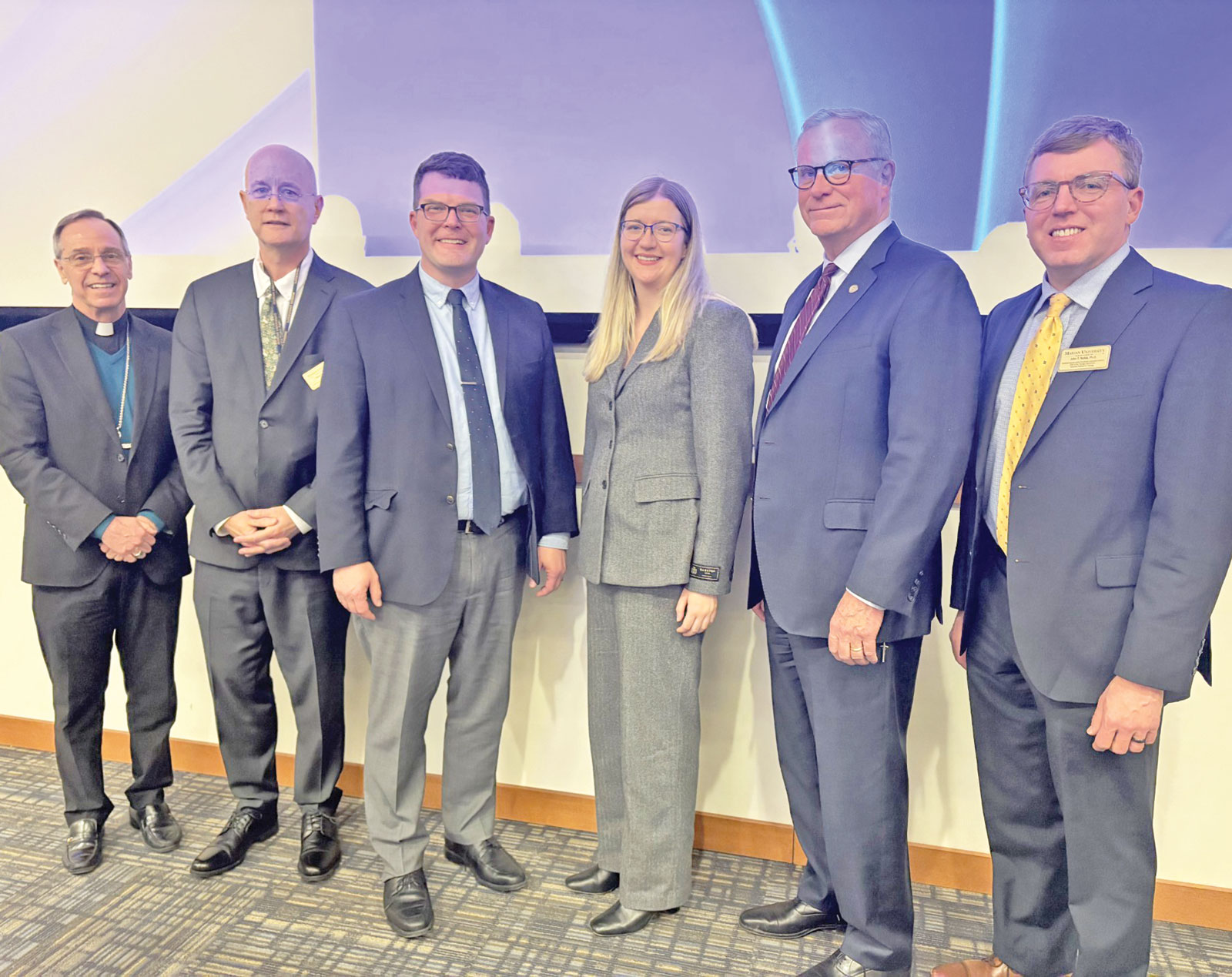
Archbishop Charles C. Thompson, left, Phil Thompson, Seth Smith, Megan Gooley, Marian University president Dan Elsener and John Noble, chair of Marian’s theology department, pose on Feb. 11 at Marian University in Indianapolis. Archbishop Thomspon, Phil Thompson, Smith and Gooley took part that evening in a panel discussion about Pope Leo XIV. (Submitted photo)
By Sean Gallagher
When any pope is elected, he is shaped by the time in which he lives and the popes who came before him.
He also has opportunities to shape that time and how the Church and future popes may carry out Christ’s mission of salvation after him.
That was the case when American-born Cardinal Robert F. Prevost was elected bishop of Rome on May 8, 2025, and took the name Pope Leo XIV. And it was the topic of a panel discussion on Feb. 11 at Marian University in Indianapolis titled “Habemus Papam: Pope Leo XIV in Context.”
The panel was made up of Indianapolis Archbishop Charles C. Thompson; Seth Smith, an associate professor of history at the Catholic University of America in Washington, D.C.; Megan Gooley, an assistant professor of theology at Marian; and Philip Thompson, Marian’s Semler Chair of Ethics.
Leo XIII’s lasting influence
In his remarks, Smith focused on how the papacy of Pope Leo XIII, who served as bishop of Rome from 1878 to 1903, might help Catholics understand better the current Pope Leo.
He described Leo XIII as having “one of the most consequential papal reigns in modern history.”
“Leo confronted the deep structural transformations of the late 19th century: industrialization, the rise of the modern nation-state, imperialism and the first stirrings of global economic and cultural integration,” Smith said. “In many ways, these are the same things that are shaping the 21st century as well.”
Commenting on Leo XIII’s groundbreaking 1891 encyclical letter “Rerum Novarum” (“On Capital and Labor”), Smith said that the pontiff tried to steer a “middle way” between socialism and unfettered capitalism in reflecting on the effects of the industrial revolution on the society of his time.
“He offered a principled vision in which the economy existed for the human person and not the other way around,” Smith said.
Whether he was laying the groundwork for modern Catholic social teaching in “Rerum Novarum” or issuing warnings about the dangers of nationalism and an increasingly interconnected global economy, Smith said that Leo’s teaching was based on a renewal in the study of and reliance on the theology of St. Thomas Aquinas that he encouraged.
Smith noted that Leo, looking to St. Thomas, held that “human reason can know real truths about nature and morality in society.”
“If there is real moral order accessible to reason and confirmed by revelation, then neither markets nor the state can define justice arbitrarily,” Smith said. “The state doesn’t get to make its own laws, and the market doesn’t get to make its own laws. Economic systems have to be judged by how they serve the human good.”
Leo XIII’s possible influence on Leo XIV
Smith also explored ways that Pope Leo XIII may be an influence on the current Pope Leo, noting the similarity between the times in which both men served as bishop of Rome.
“Like Leo XIII, Leo XIV inherits a world marked by vast structural forces,” Smith said. “Technological transformation, economic inequality, surging nationalism and international interdependence threaten to reduce human beings to data points, consumers or political gifts.”
At the same time, Smith noted that the current Pope Leo’s experience of being born and raised in America and having served as a missionary and a bishop in Peru might shape his ministry as bishop of Rome in ways that were absent in the exclusively European experience of Leo XIII.
“[Pope] Leo XIV knows firsthand the promises and perils of liberal democracy, pluralism and global capitalism,” Smith said, adding that the current pope is from Chicago, “a city which is the product of the 19th century” and its economic and social trends.
“He’s also spent most of his adult life in Peru, so he understands the impact of imperialism,” Smith continued. “These experiences may allow him to continue Leo XIII’s project with great cultural fluency and pastoral sensitivity.”
Smith said that if the papacy of Leo XIII has an influence on the current pope, “we might expect a renewed emphasis on human dignity grounded in natural law and revelation” and “a careful distinction between patriotism and nationalism, and a global vision rooted not in abstraction, but in solidarity.
“Above all,” Smith concluded, “we might expect a papacy that insists on the Church’s engagement with the modern world, but that it must always be ordered toward the salvation of souls and the restoration of right relationships between one another, Church and with God.”
Continuity between popes
Gooley focused her remarks on the relationship between Pope Leo XIV and his immediate predecessor Pope Francis who, like the current pope, spent many years leading the Church in South America before being elected bishop of Rome.
She described the hallmarks of Francis’ papacy as being a focus on the Church reaching out to serve those on the margins of society, it being “ ‘a poor Church for the poor,’ ” and synodality in which all the faithful, led by the Holy Spirit, are called to listen prayerfully to each other and work together to further the Church’s mission of evangelization.
Gooley noted a difference in pastoral style between Pope Leo and Pope Francis.
“While Francis’ style was often direct and spontaneous, Leo XIV’s approach to the papacy, at least thus far, appears to be more measured and more deliberate with a strong focus on ecclesial unity,” she said.
At the same time, Gooley said that she’s observed a great deal of continuity between the two bishops of Rome.
It is seen, she stated, in Pope Leo’s first apostolic exhortation, “Dilexi Te” (“I Have Loved You”), issued on Oct. 4, 2025, a document which Pope Francis had started but which Pope Leo completed.
Gooley noted that Cardinal Michael Cznery, prefect of the Vatican’s Dicastery for Promoting Integral Human Development, “has described this document as both 100% Francis and 100% Leo.”
“Here we can see clearly the ways that their experiences living among the poor in Latin America has shaped their moral vision and their pastoral priorities,” Gooley added.
She also noted that Pope Leo appears to be continuing Pope Francis’ focus on synodality in having already called together the Church’s cardinals to discuss evangelization and his plans to call them together on a regular basis in the future.
“Ultimately, the continuity between Francis and Leo XIV can be summed up,” Gooley said, “in their shared conviction that the Church’s mission must remain responsive to the signs of the times, proclaiming the Gospel with clarity, with credibility and with hope.”
He is ‘his own person’
Archbishop Thompson expressed his belief that Pope Leo XIV might also be influenced by Pope St. Paul VI, who led the Church from 1963-78.
In particular, Archbishop Thompson pointed to a theme in Pope Paul’s 1975 apostolic exhortation on evangelization “Evangelii Nuntiandi” as being reflected in the current pontiff.
“[He] said that if a teacher is not first a witness, their words will mean nothing,” Archbishop Thompson said about Pope Paul. “People won’t listen to someone if they don’t see their witness being lived. And I think Pope Francis truly wanted to show that narrative of the Church in that living witness. And I think Pope Leo XIV is doing that [also].”
While acknowledging with the other panelists that Pope Leo has been influenced by his predecessors, Archbishop Thompson emphasized that the current pope is “his own person.”
“He is not Francis II,” he said. “He is not John Paul III. He’s not Benedict XVII. He is Pope Leo XIV, and we’ll see that. I’m sure we’re going to see him do that in his own way.”
Pope Leo and artificial intelligence
Philip Thompson rounded out the remarks of the panelists by speaking about the approach that Pope Leo XIV appears to be taking in his comments on artificial intelligence (AI). It’s a topic that the pope described soon after being elected as potentially being as consequential for today as the industrial revolution was in the time of Pope Leo XIII.
“On his third day as pope, he addressed the cardinals and talked about how he identified AI as a challenge to our humanity, to workers’ rights, human dignity and justice,” Thompson said. “Since that point, he’s consistently talked a lot about artificial intelligence and emerging technologies.”
Thompson looked in particular to a speech that Pope Leo gave on Dec. 5, 2025, in which he said that “ ‘the ability to access vast amounts of data and information should not be confused with the ability to derive meaning and value from it.’ ”
“We are the humans,” Thompson said. “We determine values.”
He said that Pope Leo has reminded the faithful and people beyond the Church that humanity should always be “co-creators” and not just “passive consumers.”
“These technologies, as we’ve seen with social media, draw us into passivity,” Thompson said.
Thompson also said the Pope Leo has warned of the dangers that technological trends can have on young people, again quoting from the pope’s Dec. 5 speech:
“ ‘We must pause and reflect with particular care upon the freedom and inner life of our children and young people, and the possible impact of technology on their intellectual and neurological development.’ ”
“There’s a lot of science that’s developing about the harm of being on screens and what it does to your brain,” said Thompson, noting how he’s observed the challenges his students face in their use of digital technology.
He spoke strongly of the need of the Church and of society more broadly to apply sound, time-tested human values in guiding the use and development of technology.
“We can do this,” Thompson said. “We can reassert our control of our technologies and reap their positive benefits, but not reap the dangers that are coming our way.” †