That All May Be One / Fr. Rick Ginther
This Lent, let’s examine how other religions are partners in dialogue
 “True or False?” How often did you dread school quizzes and test sections that were so named?
Such juxtaposition led to either/or thinking. If an item was true, then the “other” must be “false.”
This leaves little room for “both/and,” subtleties or nuances. These lead to depth and insight for enhanced understanding.
Our choice of descriptive words is important.
“There is one true Church.”
“There is one true religion.”
These two short sentences have been used to describe Roman Catholicism and Christianity, respectively.
Yet, if there is one true Church, does that make all other “churches” false?
If there is one true religion, does that make all other religions false?
Historically, the first statement has been used by adherents of Roman Catholicism, Eastern Orthodox, Lutheran and other Christian denominations to describe themselves.
Each denomination has criteria for using the word “true.” Roman Catholics and Eastern Orthodox use the four marks of the Church spoken in the Nicene Creed—one, holy, catholic and apostolic.
These four theological terms speak of origin in the person of Jesus. He wished for his believers to be one as he and the Father are one (Jn 17:22). He mandated its holiness and universal mission (Mt 28:16-20). The Apostles thus were to be the initiators of the mission to be handed on to their successors.
Sadly, the great schism of 1053 between the West and the East persists today between the creators of the Nicene Creed. They are not one.
The Roman Catholic Church speaks of itself as the one true Church. “True” here is rooted in the consistency of holding to the four marks yet to this day.
All other Christian churches or ecclesial communities hold parts of the truth, but not the fullness. But this does not make them false. They have a share of the truth, as stated in “Lumen Gentium,” which is the Second Vatican Council’s “Dogmatic Constitution on the Church (#14-17). The same is reiterated in “Unitatis Redintegratio,” the council’s “Decree on Ecumenism.”
The statement “There is one true religion” rests on the salvific gift of the Incarnation.
God became one of us in Christ and brought about salvation for all humanity.
No other religion professes God with us in this way.
Catholic Christianity is the sacrament of salvation for the world (“Lumen Gentium,” #48).
Does this statement of salvific truth mean that all other religions are false?
Both “Lumen Gentium” and “Nostra Aetate,” also a document of Vatican II, speak of other religions as partners in dialogue. That dialogue is to pursue understanding of the truth of the divine in each religion.
While apprehension of the divine differs among religions, there are many shared qualities and “truths.” The Golden Rule is notably one of them. Another is the gift of creation and humanity’s charge to care for it.
True or false? In the context of church and religion, how we use these two words is important to greater understanding.
Holding too tightly to a narrow definition of either one does not allow for the Spirit of God to enlighten minds and hearts.
Holding too tightly to a narrow definition of either one reinforces polarization, exclusion of the other and the demeaning of others’ ability to think and believe.
Perhaps our Lenten journey this year will be a growing appreciation of truth in the breadth and depth of our Church, our religion and its relation to others of faith and religion.
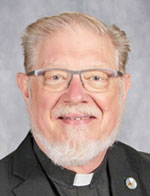
(Father Rick Ginther is director of the archdiocesan Office of Ecumenism and Interreligious Affairs. He is retired from full-time pastoral ministry, but is still active as a priest of the archdiocese.) †