School’s mental health program helps teens, including how to be there for each other
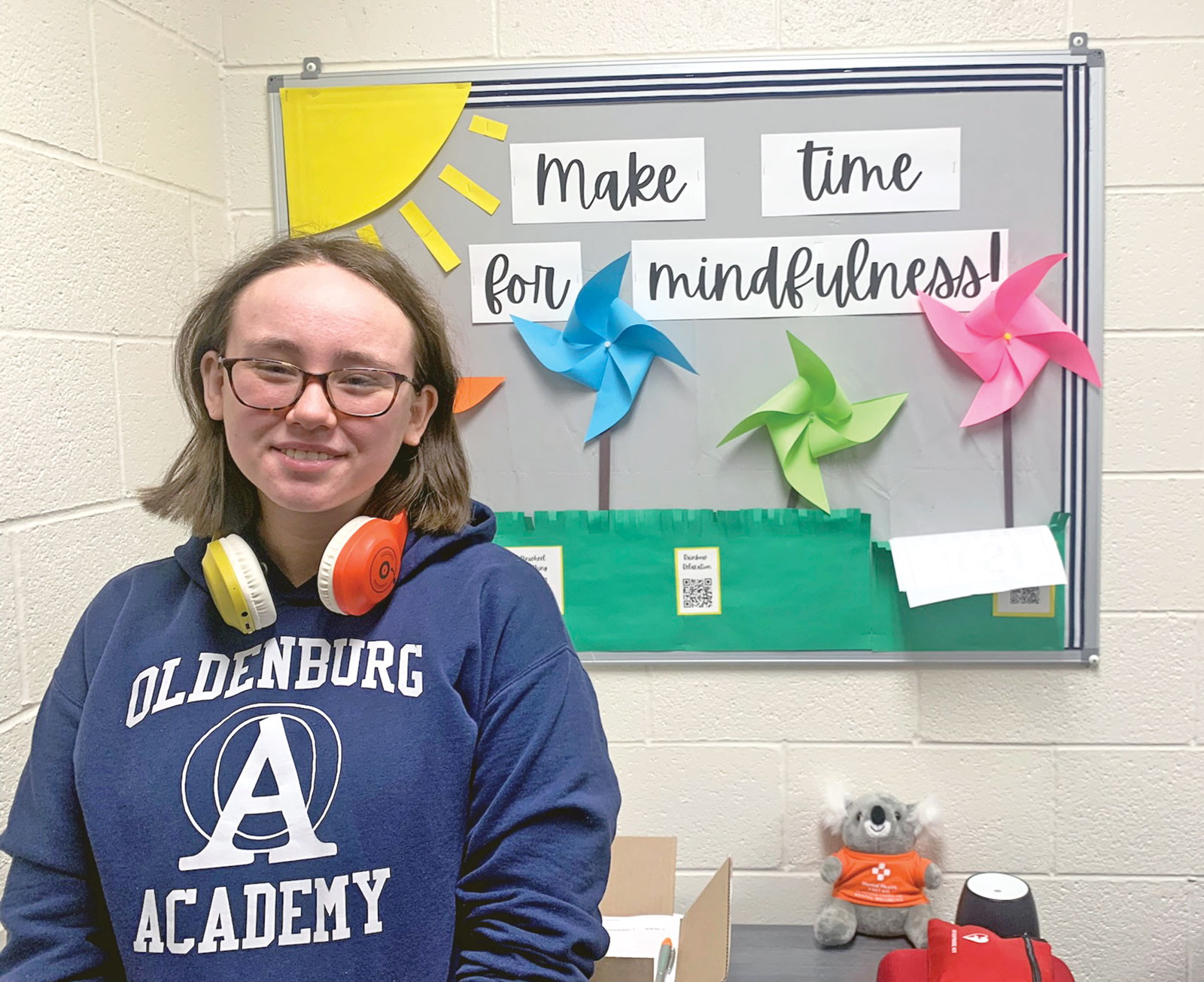
Gabi Moore has seen the difference that the Teen Mental Health First Aid program at Oldenburg Academy of the Immaculate Conception in Oldenburg has made during her high school years, a time filled with growth, challenges, close friends and struggles. (Photo by John Shaughnessy)
By John Shaughnessy
OLDENBURG—Sometimes life comes down to a friend who notices, who cares and who acts.
During his time in high school, 18-year-old Luke Hopkins saw that one of his friends was struggling with life in a way that made Luke worry.
“My friend was kind of going down a bad path mentally,” Luke recalls. “It was kind of like the world was ending.”
So, Luke sought the help of a teacher he trusted.
“We got the student what they needed at the time, so they were good,” Luke says.
That moment captures the hopeful essence of the Teen Mental Health First Aid program at Oldenburg Academy of the Immaculate Conception in Oldenburg—just one of several schools and youth organizations in Indiana that has embraced the program developed by the National Council for Behavioral Health.
“One in five adolescents will experience a mental health challenge at some point in their lives,” says Rebecca Niese, the school nurse and a science teacher at Oldenburg Academy who teaches the mental health program.
Niese also notes that more than half of teens with mental health challenges—54%—do not seek help, but they’re also more likely to ask for assistance when the encouragement comes from a trusted friend or family member.
“So, educating students on how to help a friend felt super important because if someone close to them suggests help, they are more likely to seek it,” Niese says.
As part of the program, each student gets a manual from the National Council for Behavioral Health, a manual that notes the challenges that teenagers today face:
“For teens, mental health challenges can make life particularly hard. There is a lot going on during adolescence. During the teen years, teens are reaching physical maturity [going through puberty and the final stages of brain development]; spending less time with their family and more time with friends; creating new relationships; developing a sense of identity and purpose; finishing high school, starting work, and/or going to college.
“Because there is so much going on, mental health challenges can disrupt a teen’s development in a whole range of areas. Importantly, if this disruption continues, mental health challenges can cause a person to suffer long into adulthood.”
At 16, Gabi Moore believes the program has made a difference to her and her friends at Oldenburg Academy.
‘I love that!’
“I feel that high school is a very complicated place. It’s a new environment for a lot of freshmen,” says Gabi, a junior and a member of
All Saints Parish in Dearborn County. “Their friends [from grade school] go to all different high schools, so they possibly don’t have as many friends or they need to make new ones, and it can be hard. I’ve had a hard time a little bit, but now I have my own friends, and I love them very much.
“Having the mental health program definitely helps us learn, ‘Hey, it’s OK to make mistakes. It’s OK to be weird. It’s OK to be yourself around other people and let people help you.’ ”
The program has made a huge difference on her personally.
“I make a lot of art. I normally do digital art—scrapbooking and collages and stuff like that. I always see my art as very weird, that people will see it as too freaky,” she says. “But then if I leave something on my desk, people will come up to me and say, ‘Gabi, that’s so good!’
“I love that! It’s helped a lot for me to have people encourage me and tell me they like the things that I do.”
The program has also helped her to be more empathetic to her peers.
“It’s helped me look past my own ideals and thoughts and see into other people’s point of view, to take a step into their shoes,” she says. “Or even like with one of my close friends. She was in a lot of stuff I wasn’t particularly interested in, but once she started talking to me about it, I thought, ‘Oh my gosh, this is like so cool.’
“I liked seeing that spark in her when we talked about one of her hobbies. Or she would say, ‘I don’t think you’ll like it.’ And I said, ‘No, I want to see what makes you happy.’ ”
Creating a circle of support
High school is a time that can be marked by many happy moments, growth experiences, close friends and influential teachers.
It can also be touched by struggles of self-worth and doubt, concerns about fitting in somewhere, challenges with studies and teachers, worries about the present and the future.
The mental health program provides tools to help teens deal with and cope with those tough times—both for themselves and their friends.
One of the tools involves having the teens create “a circle of support.”
“That’s five trusted adults—one can be a peer—that I can turn to if I am noticing an issue with a friend or even myself,” Niese, the program’s teacher, says. “It’s good to know who you can count on, to know you’re not alone, and that it’s OK to speak up, it’s OK to not feel OK—and just knowing again who you can go to and having easy access to those people. It’s also really thinking about why you’re choosing those people and what qualities they possess.”
The program also includes a self-love action plan.
Six approaches to live by
“They’re different things they can do to show themselves a little grace if they’re having a tough time,” Niese says, noting the plan revolves around six approaches.
The approaches start with a physical emphasis, encouraging a teen to consume nutritious foods and stay away from smoking, vaping and using alcohol or drugs. The first approach also promotes movement, as research shows “it helps improve mood and contributes to an overall healthy lifestyle.”
“Giving back” is also stressed because “helping others gives you a sense of purpose.” The third approach is to “recharge,” to find time in their busy lives to rest and regroup.
Disconnecting from social media and phones, even for a short time, is also emphasized as research shows that approach decreases stress and anxiety. With the extra time, teens are encouraged to reconnect with—and be present to—their personal relationships.
Tapping into creativity—singing, writing, making videos—also is part of the self-love plan as it helps a person express their feelings. And then there is “limit setting,” allowing yourself to say no to certain situations and invitations.
“These are things they can do for themselves,” Niese says.
She also shares the approaches that can help teens look out for each other.
Building a foundation of compassion
“We teach them action steps: Look, ask, listen, help and then that your friendship is important,” Niese says. “We talk about each of those individual items in detail. We also talk about what to look for, how to ask questions and who are some contacts, resources and trusted adults.
“I think that giving them these tools helps them to transition a little bit better into college and adulthood. Giving them the tools that ‘I can help a friend’ even makes them feel a little bit empowered, too.”
Oldenburg teachers have also participated in training to help students as part of the mental health program.
“They’re all youth-certified,” Niese says. “That’s for adults working with teenagers. It’s teaching our teachers how to use similar action steps: non-judgmental listening, giving reassurance, and encouraging appropriate professional help and also encouraging appropriate self-love.”
Luke Hopkins also relies on another foundation of his life—his faith and his relationship with God.
“My faith and my prayer have definitely helped me get through some of the rough patches,” says Luke, a member of St. Mary of the Immaculate Conception Parish in Aurora.
“Whenever I don’t know what to do or I’m struggling with one of my teachers or one of my friends or someone who is being mean just to be mean, I just give it up to God. Because it’s out of my control at that point. I just have to get through it and hold my head high.”
Even in the tough times, Luke has faith in the Oldenburg school community too.
“If I’m down or if one of my friends is, everybody can tell because it’s a really close-knit community,” he says. “If somebody is in bad enough shape, then somebody will definitely know and get help for that person.”
That’s always the hope for teenagers in this defining part of their lives. The Teen Mental Health First Aid program at Oldenburg Academy is one more foundation for that hope, says the school’s principal, Angie Parmer. She calls it “an essential part of our school culture” and “life-changing training.”
“Our first sophomore class received the training in 2022, and by this spring every Oldenburg Academy student will be certified,” Parmer notes. “We are already seeing its impact. Students are more confident recognizing signs of anxiety and depression, and they know how to support one another with care and compassion.” †