Indiana Mass, March and Rally for Life: ‘This is what being pro-life looks like’
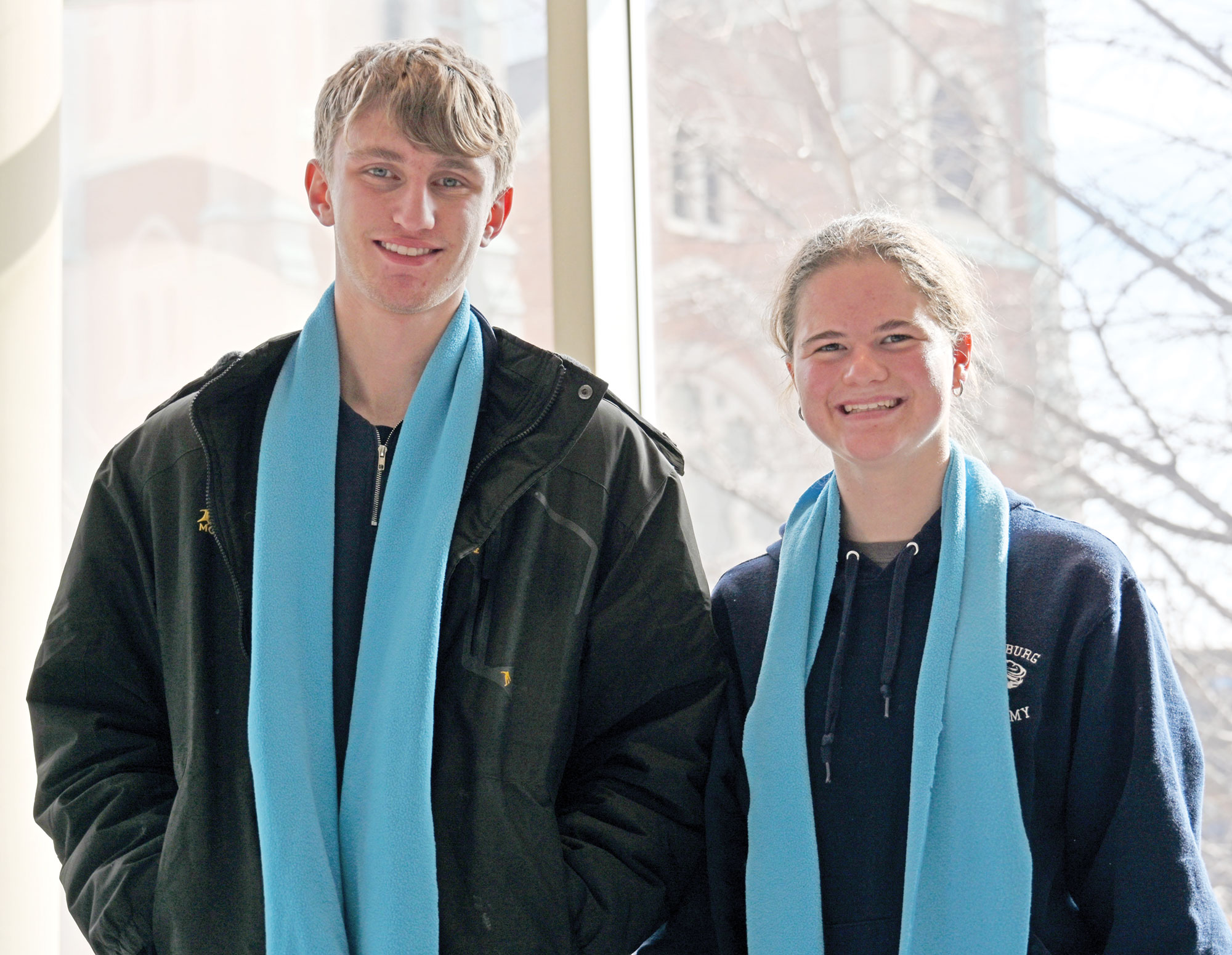
Clay Eckstein and Bridgette Ehrhard, seniors at Oldenburg Academy of the Immaculate Conception in Oldenburg, smile in the Indiana Convention Center in Indianapolis before joining the Indiana March for Life on the city’s downtown streets on Jan. 22. (Photo by Natalie Hoefer)
By Natalie Hoefer
Roughly 1,200 people served as joyful witnesses to the sanctity of life during the eighth Indiana March for Life on Jan. 22.
The date is significant.
“We march to be not only a voice for the babies, a voice for the pregnant moms, but also a voice to remember that on this day in January 1973, the Supreme Court ruled on Roe v. Wade,” legalizing abortion on demand in the U.S., said Right to Life of Indianapolis (RTLI) president Marc Tuttle at a post-march rally. “It began an era that led to the death of 67 million innocent children.
“So, we march partly to remember. But we march partly also to continue to make progress in building the culture of life right here in Indiana,” where most abortions are now illegal, he added.
The Church in the U.S. also solemnly observes Jan. 22 annually as a Day of Prayer for the Legal Protection of Unborn Children.
Before the march, 1,900 people worshiped in the Indiana Convention Center in Indianapolis at a Mass for Life, with Archbishop Charles
C. Thompson as the principal celebrant. He was joined by Bishop Kevin C. Rhoades of the Fort Wayne-South Bend Diocese and Bishop Timothy L. Doherty of the Lafayette Diocese.
Bishop Rhoades offered the homily. He thanked God for the Supreme Court’s July 2022 Dobbs v. Jackson Women’s Health Organization decision overturning Roe, returning the legalization of abortion to the state level.
But, he noted, “we still gather on this day because we know that we still have much work to do to promote a culture of life in our country and also here in our state of Indiana.”
Real love ‘must be shown by our actions’
During his homily, the bishop recalled Genesis 4:8-9 in which Cain killed his brother Abel and God asked Cain where his brother was.
“He lied,” the bishop noted. “He said, ‘I don’t know. Am I my brother’s keeper?’ ”
The answer is, “Yes, I am,” said Bishop Rhoades.
“As fellow human beings created in the image and likeness of God, we are to be in solidarity with one another, especially with those who are weakest among us,” he said, including the unborn, elderly, disabled, poor, hungry, homeless, migrants, refugees, victims of war and violence and those on death row.
“There’s a lot of indifference in the world to the plight of those who are vulnerable, whose lives are at risk,” said Bishop Rhoades. “… You know how delighted Satan is when we are indifferent to the plight of our brothers and sisters in need, especially the little ones in their mother’s womb.”
The bishop also addressed a passage from the first reading: “If someone who has worldly means sees a brother in need and refuses him compassion, how can the love of God remain in him?” (1 Jn 3:17).
“Our love for one another isn’t just a feeling or an idea,” he explained. “To be real love, it must be shown by our actions.”
Such actions include respecting and protecting the gift of life from conception to natural death, he said, because “in his wisdom and love, God transmitted his image to us when we were conceived.”
In closing, Bishop Rhoades recalled Christ’s command to “love one another as I have loved you” (Jn 13:34).
“And it’s right here at the altar that we see how much Jesus loves us,” he added. “And he loved us to the end—his body broken for us and his blood poured out for us in his sacrifice on the cross that’s made present at every celebration of the holy Eucharist.”
Through Christ’s “life-giving body and blood in holy Communion,” said Bishop Rhoades, “he gives us the grace and strength to love as he loved, to serve our neighbors in need, to bear witness to the Gospel of life with courage.”
Shortly after the Mass, many of those present went out on the streets of downtown Indianapolis to joyfully “witness to the Gospel of life” during the Indiana March for Life.
‘This is what being pro-life looks like’
Among those participating in the march—organized by RTLI—were Ana Hudspeth and Mason Schnarr. Both are juniors at Roncalli High School in Indianapolis and members of the school’s Royals for Life club.
Ana has participated in the Indiana March for Life before.
“Growing up hearing about Roe v. Wade and then when it was overturned, I started researching more and more and have just become passionate” about defending the life of the unborn, she explained.
Ana believes participating in the march is “important [for] us as young Catholics to show how important [the cause] is to us. And it kind of makes us feel a little bit more heard, too.”
As for Mason, he said defending the right to life “hits my heart.” While pregnant with him, his mother was told her unborn child had Down syndrome.
“She was given the option to abort me—and here I am today,” said Mason who was not born with Down syndrome. “There was an opportunity for me not to be here, but she chose to have me, and I was fine—I feel like that’s powerful.”
Mason was excited to experience his first Indiana March for Life.
“I know a lot of people believe [in the pro-life cause], but the idea that a lot of people, especially our age, come together and show that they believe, not just hide it—I’m awestruck,” he said. “It’s very powerful, seeing everyone come together for one purpose.”
Clay Eckstein shared Mason’s enthusiasm—and his closeness to the cause.
“I am adopted, so I kind of have a personal connection to it more than most,” said the senior of Oldenburg Academy of the Immaculate Conception in Oldenburg.
“I feel like it’s my duty as a Catholic to stand up for life. It feels like it comes down to me to stand up and help other people to get that opportunity [for life].”
As the march was about to begin, Clay admitted that, with a temperature around 30 degrees, he was glad the day wasn’t “as cold as years before. … But honestly, I just feel good about [participating in] it. I feel like I’m doing something good for other people.”
This year marked the fourth time his senior classmate Bridgette Ehrhard participated in the march.
Like Clay, she feels “really passionate that everybody should get the right to life and get to have the chance to be born.
“And I also want to support women who are in crisis pregnancies and who need that love, and to support all people at all stages of life,” Bridgette added.
She believes the march and those joining it make a difference—even though most abortion is illegal in the state.
“I think we’re setting an example to some extent to the other states in America that this is what being pro-life looks like,” said Bridgette. “I think it shows people that this is important and that abortion is an issue in our country, that there are people who love babies and love women and who aren’t afraid to stand up for the truth.”
Six speakers fired up the crowd in an outdoor, RTLI-sponsored rally before the march. Then Ana, Mason, Clay, Bridgette and some 1,200 others began their loud and proud procession “to stand up for the truth.”
Your voice does ‘make a difference’
The roughly 1-mile march ended on the south lawn of the Indiana Statehouse. There, 14 pro-life state administrators, legislators and others shared encouraging words for a second rally organized by RTLI.
Among them was Indiana Gov. Mike Braun. He said that, with the state’s current administrators and legislators, “this is as pro-life as it’s ever been in the state of Indiana. And we’re only going to take it to the next level” with policies “lined up with the sanctity of life.”
Indiana House Speaker Todd Huston noted that legislation has been passed “investing more than
$83 million to support pregnant women and their children.”
One speaker emphasized the importance of also supporting fathers.
“Over 80% of the time when we come alongside the dads and support them and the father supports the mother, the mother chooses life,” said Dawn Lang, executive director of the Life Centers network of pregnancy care centers in central Indiana.
Mike Fichter, president and CEO of Indiana Right to Life, recalled attending a pro-life rally at the Indiana statehouse four decades ago.
“And here we are 40 years later,” he said. “Every abortion clinic is closed in the state of Indiana. … Don’t ever let anyone tell you that your voice doesn’t make a difference.” †