2026 Catholic Schools Week Supplement
Scecina High School’s Catholic identity is exemplified in its cultural diversity
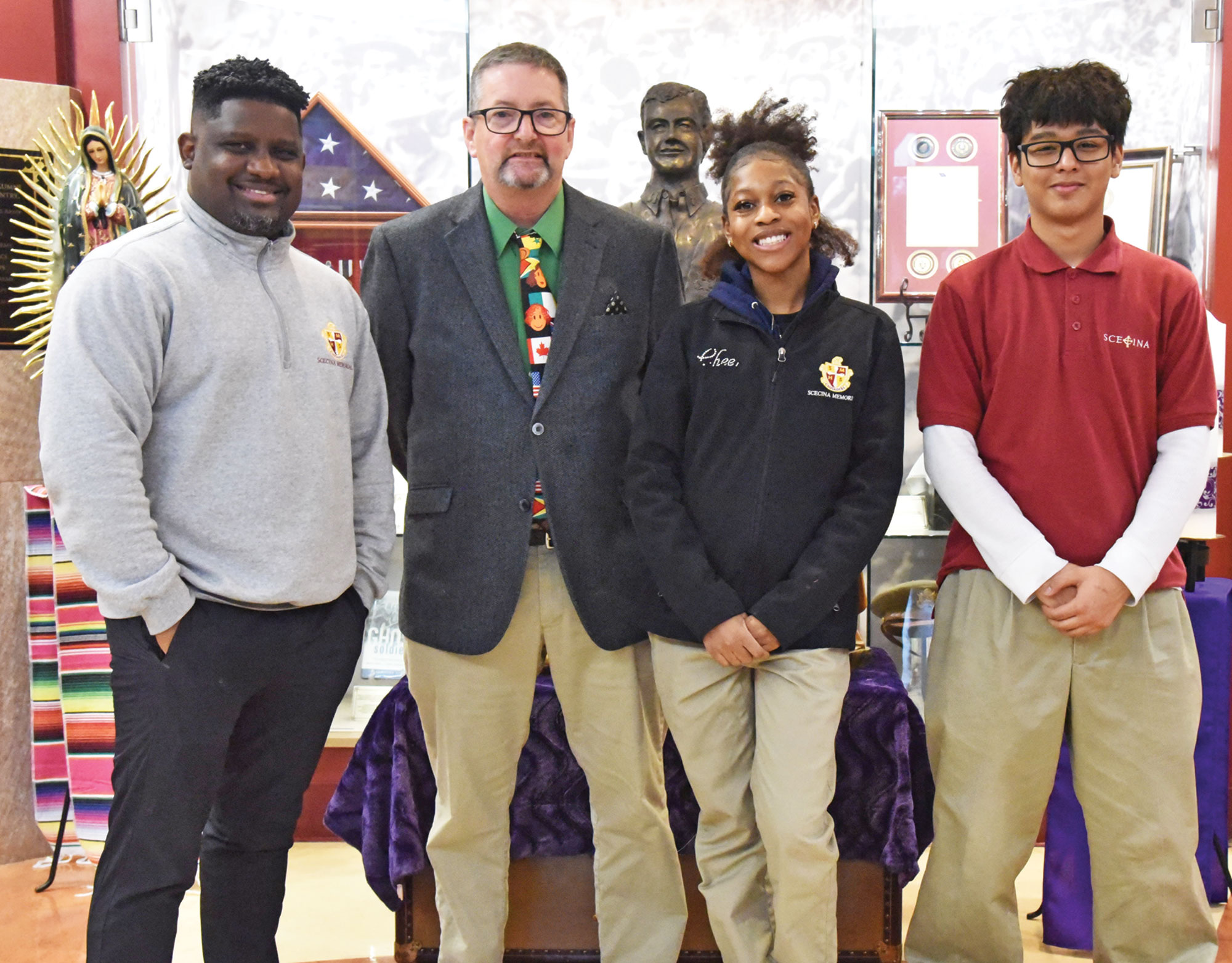
Otto Hernandez, left, John Hegarty, Onoseh Akpeokhai and Miguelangel Flores pose on Dec. 11, 2025, in the lobby of Father Thomas Scecina Memorial High School in Indianapolis. Hernandez is a teacher in the school. Hegarty is its director of international programs. Onoseh and Miguelangel are both juniors at Scecina. (Photo by Sean Gallagher)
By Sean Gallagher
Father Thomas Scecina Memorial High School on the east side of Indianapolis has about 450 students and 70 faculty and staff members.
While a decent-sized school, it’s still just a small part of the Church in central and southern Indiana.
But a closer look at the Scecina community shows it to be like a beautiful icon of the universal Church.
Many of its students are the children of parents born in numerous countries around the world who have migrated to the U.S. This academic year, Scecina also has 29 international students from 12 countries, including China, Vietnam, Thailand, Brazil, Germany, Spain and Italy.
Its teachers also hail from countries around the world such as the Philippines, India and the Dominican Republic.
“What a gift it is to have such a rich diversity of cultures, backgrounds and perspectives among the student body and staff,” said Scecina principal Peg Dispenzieri. “Diversity helps students and staff develop and use
real-world skills such as communicating across cultures, navigating differences respectfully and working with others whose life experiences are very different.”
‘It is a huge gift’
Scecina junior Miguelangel Flores came to the high school from Holy Spirit School in Indianapolis. There were many students there who were Hispanic like himself. He was born in the U.S. to parents who came to Indianapolis from the Mexican state of Jalisco. So, coming to Scecina with students and teachers from so many races and ethnicities was an eye-opener for him.
But it is a difference that he has welcomed.
“It was really interesting getting to know all these new people from different ethnic backgrounds. You learn their culture, the way that they interact,” Miguelangel said. “I’ve made a lot of friends that come from various ethnic backgrounds. It’s really cool that you get to come here and experience that.”
Onoseh Akpeokhai, a member of St. Lawrence Parish in Indianapolis, was born in the U.S. to parents who immigrated here from Nigeria in west Africa.
She appreciates how Scecina is more culturally diverse than the public elementary and middle schools she previously attended.
“I take every opportunity as a learning moment,” Onoseh said. “I can learn from a single person I meet from an Asian country or any Hispanic person that I’ve met. It’s interesting. I like it.”
John Hegarty, director of international programs at Scecina, made efforts to increase the number of its students from around the world when he served as its principal from 2011-17.
That growth took a downturn during the COVID pandemic, but it’s now back to its pre-pandemic numbers.
“It is a huge gift,” said Hegarty, who over the years has hosted dozens of international students in his home. “Our students get the opportunity to see the United States through the eyes of someone who’s not from the United States, the good and the bad. I think that’s huge.”
Otto Hernandez, a Spanish teacher at Scecina who is from the Dominican Republic, says the benefits of diversity at the school enrich all of its students.
“International students can have a stereotype of what America is,” said Hernandez, who also has hosted many international students. “Then, when they come over here, they face the reality. This is not what they watch on the news or see in the movies. This is a whole different thing.
“And it’s the same for our kids [from the U.S.]. The majority of these kids have never been out of the United States. These international students give them the chance to experience the culture of all those countries right here.”
‘We’re all children of God at the end of it all’
Dispenzieri emphasized that the broad array of cultures and races represented at Scecina is an expression of the Catholic belief in the dignity of all people as created in the image and likeness of God that stands at the heart of the school’s Catholic identity.
“Diversity allows students to encounter that truth firsthand—seeing God’s image expressed in many cultures, languages and backgrounds,” she said. “A diverse school embodies the very meaning of the word ‘catholic,’ which means ‘universal.’ ”
Onoseh and Miguelangel agreed.
“We all come together for one common goal,” said Miguelangel. “We’re all trying to get closer to God.”
“We’re all made in the image of God, no matter if we come from the eastern part of the world or the northern part of the world,” Onoseh said. “We’re all children of God at the end of it all.”
Hernandez hopes that students at Scecina learn from this belief in the dignity of all people, and how they in the U.S. have deep connections with other peoples around the world.
“This is a great country, one of the greatest countries ever,” he said. “We call it the country of freedom. But we still need one another. The United States needs the help of other countries, help from other peoples.
“It doesn’t matter if someone comes from Peru, El Salvador, Ecuador—we’re all the same.”
Hegarty said that Scecina’s racial and ethnic diversity “magnifies the fact that we’re all created in the image of God.”
“When you can see that on a daily basis that this image is not exactly the same, but it is still the image of God, I think that in itself creates respect.”
And he’s seen this Catholic belief put into action in the school where students rub shoulders with so many peers who are so different from them at an age when fitting in is often highly valued.
“I never see any disrespect,” Hegarty said. “I never hear any of the international kids say they’re being bullied or they’re being made fun of because of their accent.”
‘It’s just preparing you even more for the outside world’
While racial and ethnic diversity are valued at Scecina, it can be a challenge at times, especially for its international students, something that Disipenzieri says the school community helps them overcome.
“We have a very specific onboarding process for the students who join us from different countries,” she said. “We have specialized classes for those whose English is not yet fluent, then the rest of the student body takes if from there, welcoming new students through class discussions, athletics and extracurriculars.
“Sharing in introducing someone new to our community creates a sense of shared identity without requiring everyone to be the same.”
Onoseh and Miguelangel both remarked how their experience of being fellow students alongside peers from so many countries and cultural backgrounds is preparing them well for life as an adult in a very diverse world.
“Going through what you go through here, seeing everybody having their own opinion, their own stand on certain circumstances, it’s just preparing you even more for the outside world,” Onoseh said.
“The diversity here and getting to interact with so many different people from so many different backgrounds really helps to give you an idea of the world that we’re going into,” Miguelangel said. “It really helps you to learn how to interact, not just with people from specific cultures but people in general.”
(For more information about Father Thomas
Scecina Memorial High School in Indianapolis,
visit www.scecina.org.) †