Lights in the darkness: movies that promote truth, beauty and goodness
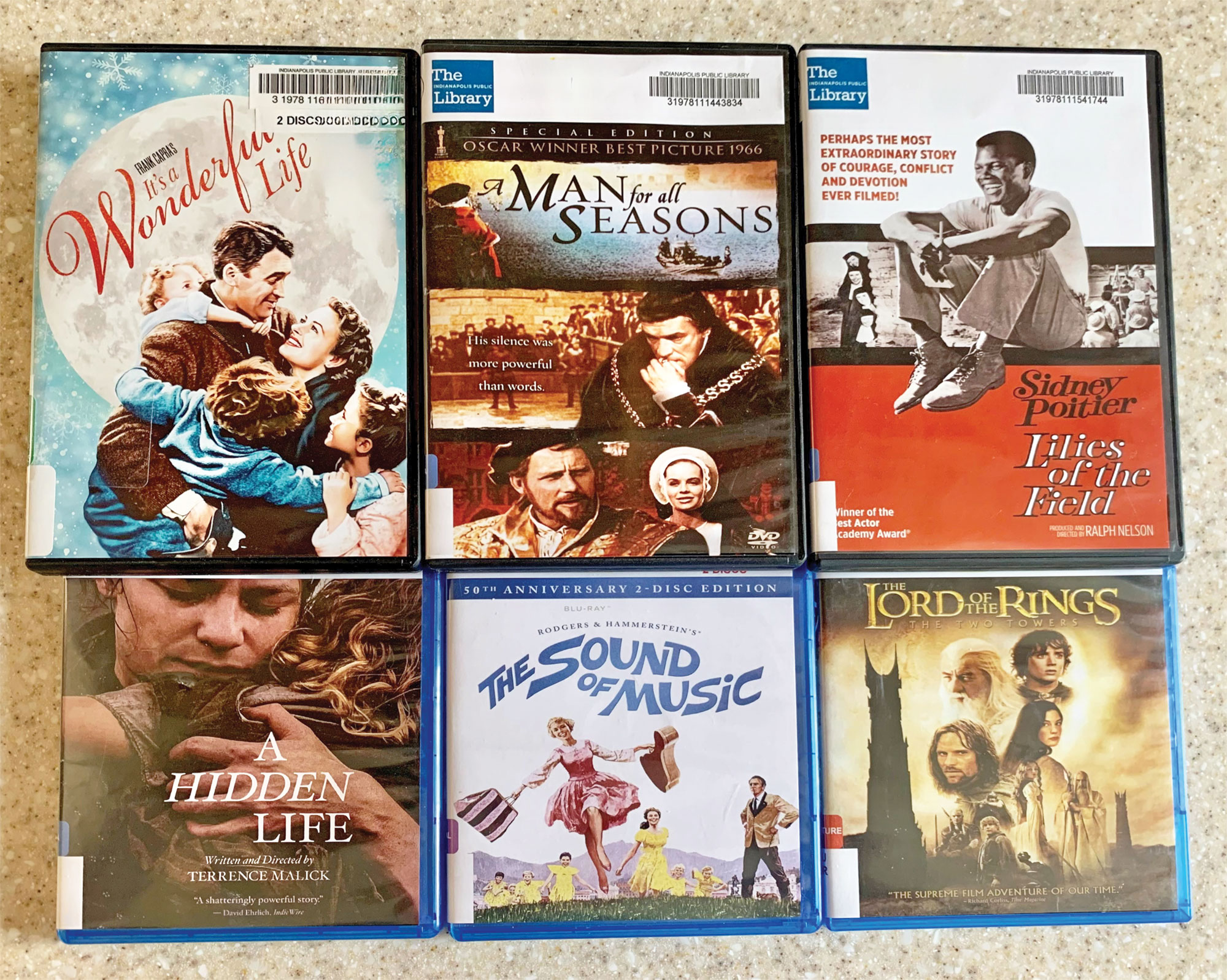
Here are some of the movies that a group of young adult Catholics recommend as “should-see” for Catholics. (Photo by John Shaughnessy)
By John Shaughnessy
Phil Thompson doesn’t cry easily. but his tears flowed when he watched the movie The Spitfire Grill, the redemption story of a young woman who gets out of prison and seeks a home and healing.
Thompson’s tears turned to cheers while watching
The Lord of the Rings trilogy, savoring the fellowship, drama and adrenaline of a classic battle between good and evil.
And he was filled with awe as he watched A Man for All Seasons, the Academy Award-winning depiction of St. Thomas More’s inspiring commitment to stay true to his conscience, his faith and God, even to the point of death.
In one way, Thompson’s appreciation of these films reflects his lifelong love affair with movies.
“I’ve loved movies since I was a little kid,” says Thompson, a member of St. Pius X Parish in Indianapolis. “The first movie I ever saw was Mary Poppins, with Dick Van Dyke and Julie Andrews. I just loved it. I thought, ‘This is magical.’ There’s animated penguins dancing with Dick Van Dyke. I was just mesmerized by the whole process.”
He still is, but his love of movies has also expanded to a deeper focus, one that connects to the Catholic faith that is at the heart of life for this associate professor of theology and the Semler Chair of Ethics at Marian University in Indianapolis.
He shared that deeper focus during a talk he gave to a group of Catholic fathers in Indianapolis earlier this year, placing his emphasis on movies that dads could watch with their families, films that have a core of faith-related qualities.
“Jesus didn’t tell us what we wanted to know in the form of high theological treatises. He used stories—parables that people could relate to,” Thompson told the group called Fraternitas, a program developed by Marian University in Indianapolis to help dads grow in their faith.
“We are people of stories. He knew that.
“There are a lot of movies which exemplify very good themes for us. Movies that are inspiring will have truth, beauty and goodness in them. If they’re doing that, that tells you that you are on the right track.”
A parent’s discretion
At the same time, Thompson advises parents to avoid movies “with unnecessary violence, excessive bad language, sexual promiscuity or toilet humor.”
Yet, as with all rules, there are exceptions, all at the discretion of what a parent believes is right for a child at an appropriate age, he says.
“Schindler’s List and Saving Private Ryan are movies with violence in them. But what’s the purpose of the violence?” Thompson says. “Naturally, Saving Private Ryan deals with war, so violence is a part of it. But the violence doesn’t override the underlying moral themes of the movie.”
Use of crude language can particularly be a challenge.
“It’s hard to find a movie without any bad language. It doesn’t have to be totally pure,” Thompson says, citing The Spitfire Grill as an example of a movie that has words that may offend viewers. “It’s just that if every other word is a bad word, then it’s problematic.”
He also encourages parents to use “bad moments” in a movie as a basis for discussion with their child or children—“This is what we don’t want to happen,” “Why is this problematic?”
‘That’s one the whole family could watch’
In his search for movies that promote “truth, beauty and goodness,” Thompson looks for ones that have Catholic themes of human dignity, grace, redemption, wisdom, conscience, justice, solidarity, common good, conversion, care for the poor and fortitude.
All conversations about a good movie for him start with how it portrays and promotes human dignity.
“Or maybe there’s a violation of human dignity that’s going on, and it offends our sense of what human dignity is. This is the fundamental value in all of Catholic ethics,” he says. “Does it promote human dignity or not? If you get nothing out of this list—human dignity—start there.”
A relatively current movie he recommends is Boys in the Boat.
“It’s about the rowers of the United States in the 1936 Olympics in Berlin,” Thompson says. “It’s all about how in the middle of the Depression these guys come together at the University of Washington and become this incredible team against all odds. No one thinks they’re going to win the United States championship let alone the Olympics in Berlin.”
Another favorite movie of his—one he considers appropriate for children of all ages—is The Sandlot.
“I defy anybody to reject The Sandlot,” he says about the movie that celebrates childhood friendships. “That’s one the whole family could watch.”
Growing together in the light
Thompson’s interest in movies led him to write Lights in the Darkness: Exploring Catholic Themes in Twelve Extraordinary Films. (See below for the list of these
12 movies.)
“Scripture says, ‘The people who sit
in darkness have seen a great light’ [Mt 4:16]. I have this at the beginning of my book. And ‘lights in the darkness’ is what a movie does. What I wanted to find in the films was the light which is Jesus Christ.”
For Thompson, the goal is to help parents and children grow together in that light through movies.
“Children have immense curiosity and imagination,” says Thompson, the father of a grown son. “Movies are an amazing source of inspiration in developing the imagination in the right way, if you get the right films. If we can direct children toward films or TV shows or books that are faith-filled or have faith themes in them, it can be a tremendous way to work together on our faith.”
He also offers parents a piece of valuable advice he learned from his father.
“My dad was a very wise man. He said, ‘You don’t mold children, you unpack them.’ We have to nurture them in the right direction.
“One thing I would say for parents, find what your child or your children like. Find out what they’re excited about. If they like animals, look at nature films and documentaries. If they’re into history like I was, find some exciting films about historical events or figures.
“Take them where they are, what they like and match that up with movies, books or art that are consistent with our Catholic faith.” †
Related: