As a woman prepared for her death, she received a miracle of faith, hope and love
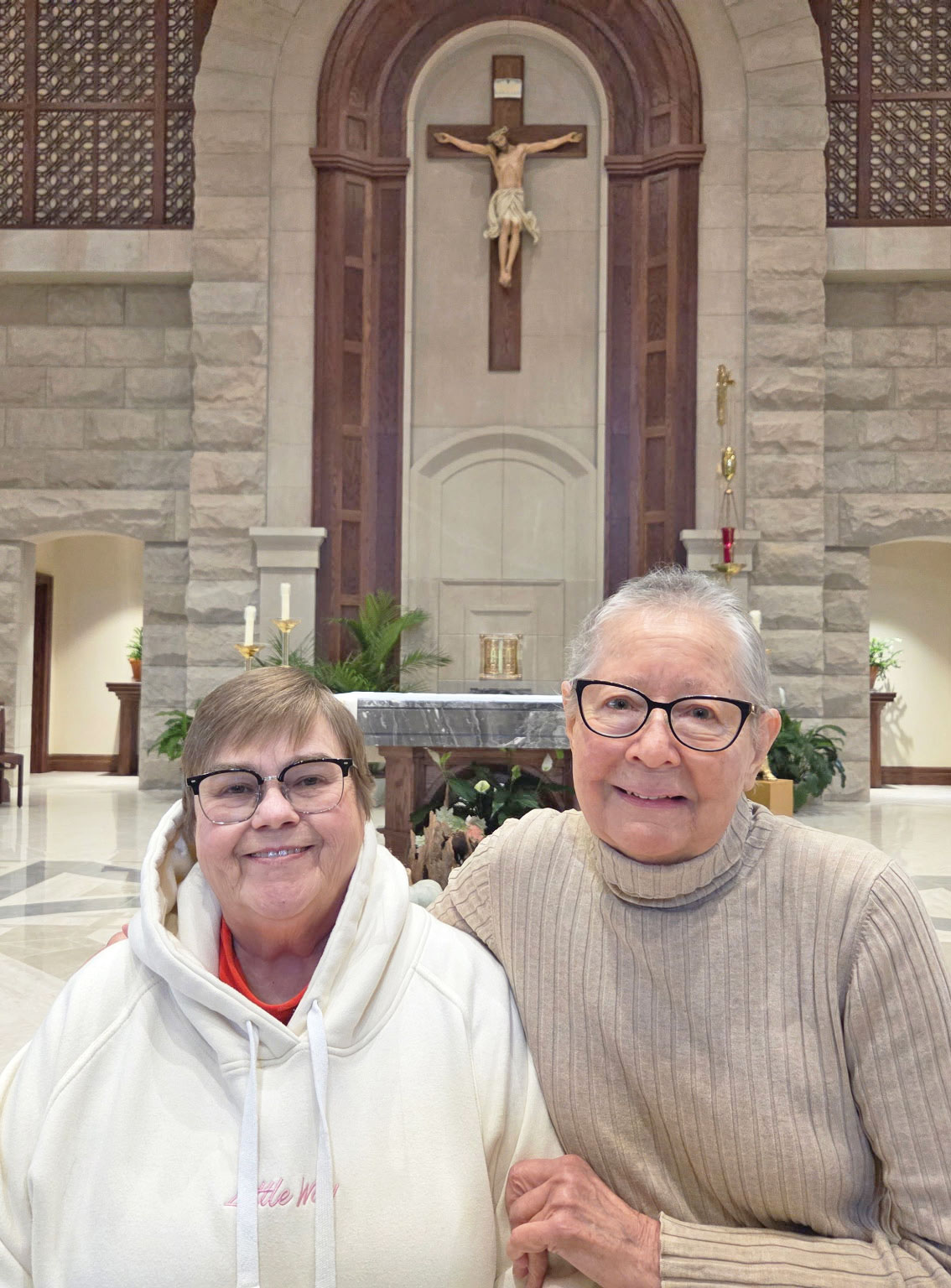
An amazing gift of friendship between Dr. Lynell Chamberlain, left, and Elizabeth Yetter has its roots in their shared faith in God. The friends pose for a recent photo at St. John Paul II Church in Sellersburg. (Submitted photo)
(One in a continuing series of stories about “Pilgrims of Hope” in the archdiocese)
By John Shaughnessy
Elizabeth Yetter had reached a breaking point—getting the kind of devastating news that would challenge nearly all of us, leaving her shaken and scared.
She had long tried to take care of her health, staying active by walking and exercising. Then came a time when she felt exhausted just doing her regular chores.
She went to her doctor, who ordered blood tests that revealed her white cell count was elevated, which led him to send her to a hospital to be checked further.
There, she learned she had cancer.
“I was diagnosed with acute myeloid leukemia [AML], which is very aggressive,” says Yetter, a member of St. John Paul II Parish in Sellersburg. “I was overwhelmed. It was scary to think I was going to die.”
In that moment in July of 2024, she prayed for a miracle.
Seventeen months later, the 73-year-old Yetter believes she has received one, a miracle touched by friendship, faith, love and hope.
‘I started to plan for the end of my life’
The heart of her story begins with the daunting, two-part reality check about beating the odds that Yetter received from Dr. Mohamed Hegazi, her physician at the University of Louisville Health–Brown Cancer Center in Kentucky.
First, he told her she would need a stem-cell transplant. Then, if a match was found, she would need someone to care for her for 70 days in isolation after the transplant.
“He said he would do everything to help me live with a transplant, but there is another half of the equation—the caregiving when you go home,” Yetter says. “He told me, ‘You cannot be alone at home after hospitalization for a transplant.’ ”
Yetter doesn’t have children, and she knew her siblings were either too old or too far away to help her for so long. So, she asked Hegazi about other options.
“When I asked about nursing agencies, he said it was out of the question to have an agency of nurses’ aides come into my house around the clock because I was prone for possible infection. And hiring an individual from an agency to stay with me 24 hours a day for the few months of isolation would be very expensive.
“It all didn’t seem to be in my reach to have this transplant. And I started to plan for the end of my life. I had my attorney draw up a will. I bought a plot in the cemetery of our church and a headstone. I was going to try to make the most of my life, but I was preparing for the worst.”
Yet, that’s when her miracle of friendship, faith, love and hope started to unfold.
‘They continued to extend my life’
An Episcopalian for most of her life, Yetter was invited by her best friend, Kathy Wesson, to join a Bible study group at St. John Paul II Parish in 2021. Soon, Yetter was part of one group on Mondays and another on Tuesdays.
During the months of sharing that followed, she felt embraced by these women, which inspired her to enter into full communion of the Catholic Church in 2022. And when the news of her cancer diagnosis spread to the groups, their faith and their caring quickly enveloped her.
Their response began when Yetter had radiation therapy and chemotherapy infusions to fight the cancer as she waited for the possibility of a transplant.
“These wonderful ladies didn’t want me to die without a chance to be saved,” Yetter says. “They started to think of a plan to take me to my appointments. After I received my appointment times and dates, the
dates would go out to the groups,
and the girls would volunteer their
time and rotate the responsibility of driving me to my scheduled appointments.
“That continued to extend my life as I waited for a possible transplant and somehow a caregiver.”
The need for a caregiver was resolved on an October evening in 2024, a moment that still overwhelms Yetter with emotion and gratitude.
‘I couldn’t believe anyone would do such a thing’
She received a phone call from Dr. Lynell Chamberlain, a retired physician, Yetter’s confirmation sponsor and a member of both Bible study groups.
“When she called, these were her exact words, ‘I think I have a plan for you,’ ” Yetter recalls. “She asked me to think about staying in her house instead of her coming to my house. She said, ‘You would have your own room, your own bathroom, and there would be an exit door where you could walk on the deck and do your thing outside.’ ”
Yetter pauses as emotion fills her again about that memory.
“I couldn’t believe anyone would do such a thing and be so dedicated. And this is the respect for life she has. She’s just a wonderful person.”
Chamberlain downplays the praise.
“If you take seriously Jesus’ message to his disciples, it’s basically, ‘You are here to serve others,’ ” she says. “If there’s a need, simply go ahead and address it. Don’t sit around and wait for somebody else to do it.”
Actually, Chamberlain was sitting around when she made the life-changing decision to invite Yetter into her home.
“I was sitting and praying about it one morning,” Chamberlain recalls. “I was looking around my bedroom. It’s not huge, but it’s a generous-sized bedroom that has its own private bathroom, and its own entrance, so you don’t have to go through the rest of the house. I was thinking, ‘It’s a shame she doesn’t have something like this.’ It was one of those moments where you strike your forehead and say, ‘Well, she could.’ So, I set about seeing if she had any interest.”
Yetter did. Still, the plan to provide help during isolation was just one part of the equation for Yetter. Months passed as she waited and hoped for a match so she could have the stem-cell transplant.
‘The doctor was so excited for me’
“These girls were doing so much for me, and my body is failing. And this can’t go on,” Yetter says about those months of waiting, choking up again. “I was getting very nervous there wouldn’t be a match, and all their efforts would be in vain.
“Then the word came out that there was a donor. The girls’ prayers were answered, and so were mine.”
She received news of the match in April—a match that was everything Yetter and Dr. Hegazi had hoped for.
“A perfect match for a stem-cell transplant for someone who has AML, according to the doctor, would be a young male in his twenties with the same make-up as mine,” Yetter notes. “My direct family members were too old or too distant down the line of relatives to qualify. I had to go through an international donor list to find exactly what the doctor had wanted, if there was such a donor. And it happened. Exactly what the doctor had wished for. A full match.
“A full match is rare and hard to come by. But this young man and I have the same chromosome make-up. It was amazing. The doctor was so excited for me. This also was something that my sisters in faith were praying for.”
Yetter had to endure and pass medical, physical and mental exams to determine if her body could accept the transplant. Once she did, the procedure was scheduled for April 25 of this year, five days after Easter.
On the day before she went to the hospital—Easter Sunday—the women in her Bible study groups gave her a gift to help sustain her in the days ahead.
The promise of a new life
“These girls selected their favorite psalms out of the Bible, wrote them on a little piece of paper and put them into one of those large plastic Easter egg shells, the ones that come apart,” Yetter says. “The gesture was very symbolic to me. Jesus was resurrected, and I was going to my own transformation. A new life. It was just a message from God, I believe.”
Yetter also drew strength from her favorite Bible verse, Jeremiah 29:11. “For I know well the plans I have in mind for you, says the Lord. Plans for your welfare and not your woe. So as to give you a future of hope.”
On the day after Easter, Yetter entered the hospital for three days of chemotherapy, one day of radiation and the transplant on the fifth day. A month of isolation in the hospital followed. During those days, the outreach of her Bible study friends continued.
“They sent me links to songs and sent me cards in the hospital,” she says. “And every day while I was in the hospital, I’d take out one of the psalms they gave me, take a picture of it, and then send it back to them and thank them so much for their blessings and their prayers.
“These girls are so wonderful.”
Then came her release from the hospital to begin 70 days of isolation in the home of Chamberlain—another time of generosity and unexpected grace.
‘It was exactly what I needed’
“In those days, you go through this transformation of your body trying to adjust to your new DNA and your new blood type,” Yetter says. “Lynell knew all of this as a critical care doctor.
“But she had never been on the other side of the spectrum as a nurse. She had to be instructed how to use an infusion pump. She was giving me doses of medication through the pump. It was a crash course for her. She knew I didn’t have much of an appetite, that I was always tired, and to watch out for infection. I couldn’t believe anyone would be so dedicated.”
As good as Chamberlain’s care was, so was the setting of her home for Yetter’s recovery.
“She lives on a farm. She has 60 beautiful acres, trees and a creek. She has goats and chickens, dogs and cats. It was so pleasant. It was exactly what I needed, what my body needed.”
Then came a time that was hard for Yetter—when Chamberlain started to limit her presence to her friend near the end of the isolation period.
“Toward the end, I was wondering why she wasn’t spending so much time with me,” Yetter recalls. “I confronted her one day. I said, ‘Lynell, I feel abandoned.’ She said, ‘You shouldn’t. I’m trying to let you live your life. I’m trying to bring you back to your independence. One day, you’ll be alone soon.’”
‘Miracles do happen’
Back home for a few months by herself, Yetter is still in a period of transition, of caution.
“Because of the chemo, your immune system is just about zero, so you’re open to a lot of infections. I still have to be careful in what I do,” she says. “I’m still under the care of the team, and I won’t be clear of everything until five years from my transplant. I’m still in remission.”
At the same time, she has an immense feeling of hope, all in the belief that God has been through everything with her—and will continue to do so.
“I’ve had a good relationship all my life with God. I always knew he was with me,” she says. “I would tell people, ‘Never lose your faith. God is there for you. God is listening, and miracles do happen.’ ”
Often, they’re the kind of everyday miracles that come through the people whom God places in a person’s life—the people who share their gifts of friendship, faith, love and hope.
Yetter may live by herself, but she knows that Chamberlain and her other Bible study friends are always there for her.
“This year, my word for the year was hope,” Yetter says. “I’m truly blessed. The doctor said, ‘You can’t do this alone.’ I haven’t had to. The dedication of my church family, and these women especially, deserve the credit.
“All things are possible with the love and faith and support you have from God, and the gift you receive from others.”
(In this Jubilee Year for the Church with the theme, ‘Pilgrims of Hope,’ The Criterion has invited you, our readers, to share your stories of hope—how embracing hope has helped you in the toughest moments of your life, how others have given you hope for your future, how your faith in God has sustained you and uplifted you. We will continue to offer this opportunity into the new year and beyond. If you have a story of hope to share, please send it to John Shaughnessy by e-mail at jshaughnessy@archindy.org or by mail in care of The Criterion, 1400 N. Meridian St. Indianapolis, IN 46202. Please include your parish and a daytime phone number where you can be reached.) †