ASL interpreters help deaf participants feel more connected at NCYC
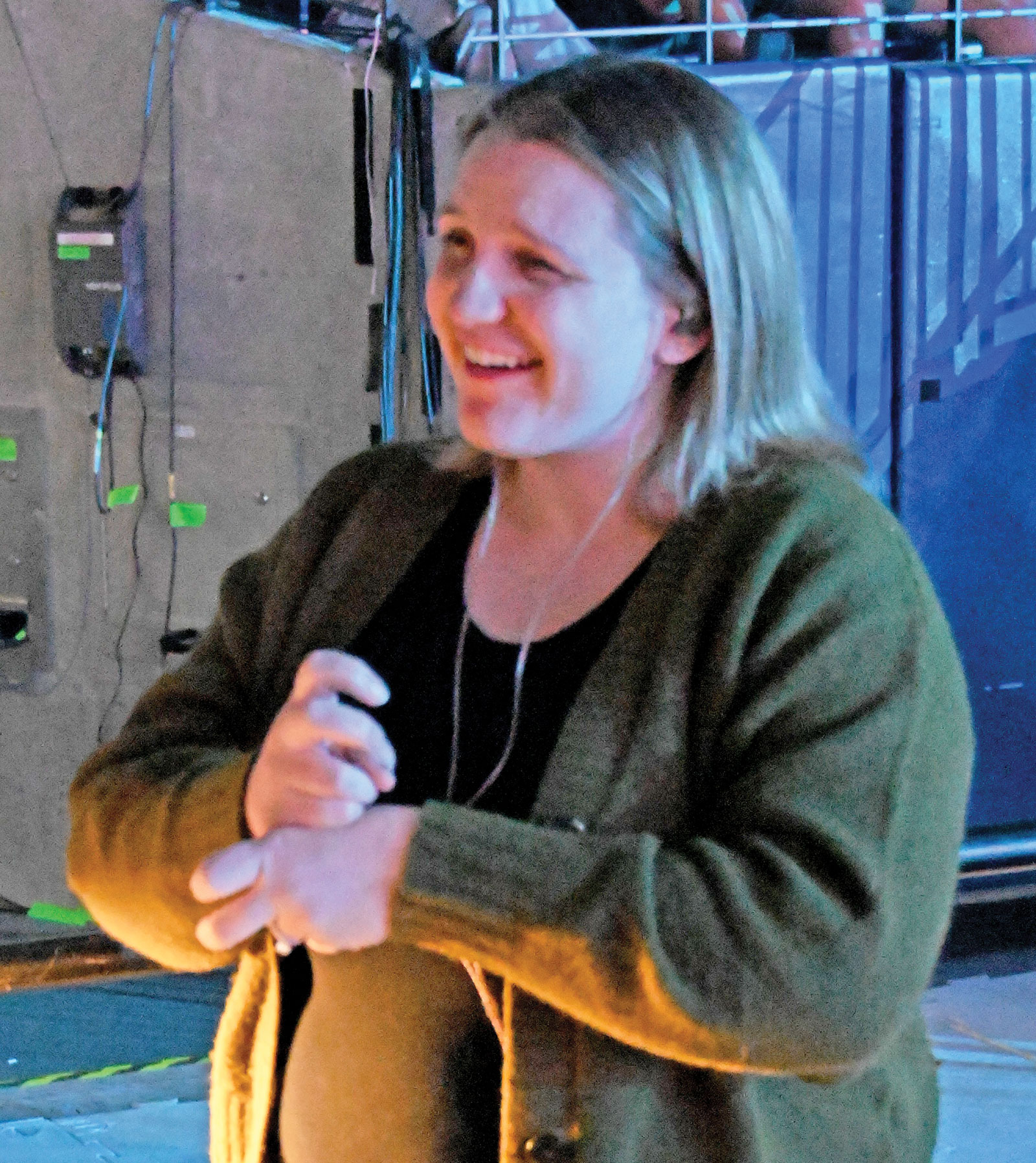
Megan Kenworthy signs during a general session in Lucas Oil Stadium in Indianapolis on Nov. 21 during the National Catholic Youth Conference. (Photo by Natalie Hoefer)
By Natalie Hoefer
As youths from throughout the country gather in Indianapolis every other year for the National Catholic Youth Conference (NCYC), they bring many needs.
There are spiritual needs, of course. Perhaps some have social, emotional or intellectual needs, too—or all of the above.
And sometimes there are a handful with a specific need: interpreters who know American Sign Language (ASL).
No participants requested that need during this year’s conference on Nov. 20-22.
But that fact did not discourage three ASL interpreters from signing during the NCYC events held in Lucas Oil Stadium “just in case” the need arose, says Megan Kenworthy, a nationally certified, professional ASL interpreter.
She first assisted signing at NCYC when she was in college.
“I can’t remember if this is my third or fourth time” signing at NCYC, says the member of St. Simon the Apostle Parish in Indianapolis. But she has enjoyed each experience.
“It’s fun being on the stage as an interpreter” in front of the small section in the stands of the stadium reserved for the deaf during NCYC, says Kenworthy.
“You see the emotions. There’s kids crying and holding each other, and they have so much fun singing praise music.”
The 27-year-old started learning ASL in college when she was 18. She went on to earn undergraduate degrees in American Sign Language and linguistics at the former Indiana University-Purdue University of Indianapolis, and a master’s degree in linguistics at Ball State University in Muncie, Ind.
ASL interpreters at NCYC are paid by the National Federation of Catholic Youth Ministry.
Kenworthy also interprets for the local Church through the archdiocesan Disabilities Ministry, receiving payment from the archdiocese.
She occasionally signs at archdiocesan Masses, like the St. Martin de Porres feast day Mass held this year at Holy Angels Church in Indianapolis on Nov. 3, or at a recent confirmation Mass held at SS. Peter and Paul Cathedral in Indianapolis.
“Catholicism is already another language of itself” with unique words and terminology, she says. “Putting it into another language [ASL] is challenging.
“American Sign Language is not just taking English words and signing them word for word. You have to completely change gears.”
For instance, ASL has specific grammar and linguistics, Kenworthy explains.
“So for me, when it comes to signing, it’s like, ‘What is this message? What does this idea mean? What is this sentence trying to say in a deeper meaning?’
“I really have to try to take [the spoken message] apart, digest it and put it out in a way so it’s an understandable message and more than just the blanket statements.”
At events like NCYC, there are two interpreters together at all times, says Kenworthy. They alternate signing every 15 minutes “to avoid burnout and fatigue,” with “the ‘off’ interpreter supporting the ‘on’ interpreter if we miss something or just need extra support.
“So, you’re not ever really off for 15 minutes, but you’re not the center of attention.”
When there are no deaf participants registered for NCYC, the interpreters only sign in the stadium for the four general sessions and the closing Mass, each lasting two-and-a-half to three hours.
But when an NCYC registrant indicates the need for an ASL interpreter, “We do the breakout sessions with them and everything else, too,” she says.
“It’s a lot,” Kenworthy admits.
It was even tiring this year with no deaf participants but only three ASL interpreters for the five gatherings in the stadium.
“But then seeing the kids all hyped up by the music, you can feel the energy in the room, and it rejuvenates you to keep going.”
There are the emotional rewards, too.
“At the NCYC two years ago, there was a student who didn’t even know that she could have an interpreter until she got here,” Kenworthy recalls. “I remember her and her brother were crying together, and she was like, ‘I just feel so connected’—she even signed that during the [closing] Mass.
“So, that was really cool, to feel like she was being connected and not struggling through the language.”
Kenworthy feels making that connection possible is especially important for the youths at NCYC, even though the largest number she’s signed for in the stadium was six.
“This is a time where sharing and growing in the faith is fun, it’s exciting,” she says. “Your friends can be here and support you at the same time. That [experience] can make a difference later, when some start to drift away from the Church.”
Whether it’s at an archdiocesan Mass or NCYC, “It’s just fun to see people worshiping in another way, in another language, to just build that connection stronger” with each other and the faith, says Kenworthy.
“It’s definitely an amazing way to lead and worship and help the Church.”
(For Catholics who know ASL and are interested in using your talent to serve the Church in central and southern Indiana, contact archdiocesan Disabilities Ministry coordinator Jenny Bryans at 317-236-1448 or jbryans@archindy.org.) †
See more stories from the National Catholic Youth Conference here