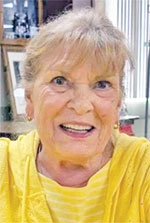
Jane Crady follows God’s lead to give hope to people devastated by disasters
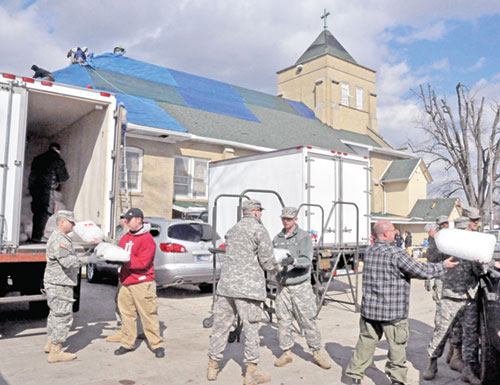
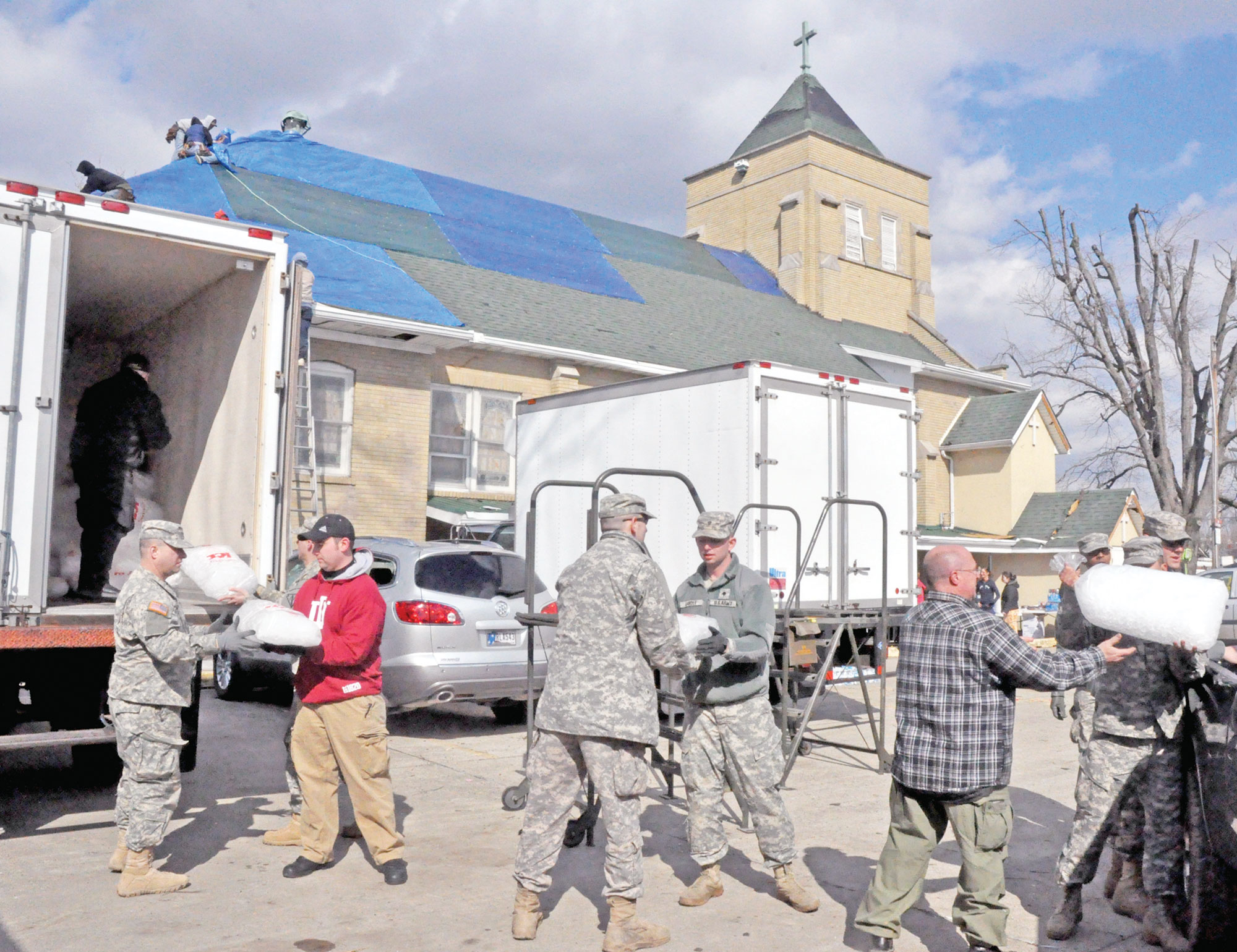
Members of the Indiana National Guard and other rescue workers haul donated ice to a refrigerated truck parked beside St. Francis Xavier Church in Henryville on March 3, 2012. The previous day, a tornado ravaged the southern Indiana town. As the coordinator of disaster preparedness and response for the archdiocese’s Catholic Charities, Jane Crady has responded to this natural disaster and many others in Indiana and around the United States in the past 20 years. (File photo by Sean Gallagher)
By John Shaughnessy
After all the heartbreak and devastation that Jane Crady has seen in the past 20 years, it’s a wonder that this great-grandmother of four isn’t looking for something more peaceful to do.
Instead, Crady still heads into the heart of natural disasters, doing everything she can to help people whose lives have been torn apart by hurricanes, tornadoes and floods.
It all started in 2006, months after one of the worst hurricanes in American history—Hurricane Katrina—ripped through the southern states along the Gulf Coast. Believing God was calling her to help, Crady left her home in Indiana and traveled to Waveland, Miss., where the eye of the hurricane hit. She stayed there for the better part of three years, including the time she lived in a tent on a beach.
In the years since, she has dedicated her efforts in Indiana as the coordinator of disaster preparedness and response for the archdiocese’s Catholic Charities.
She was there helping people recover from the 2008 floods that overwhelmed Martinsville, the 2011 floods that swept through Bloomington, and the 2012 tornadoes that led to tragedy in Henryville and other places in southern Indiana, damaging hundreds of homes and killing 13 people. And she was all across Indiana last year when 56 tornadoes touched down across the state. (Related story: Catholic Charities Indianapolis receives national award for helping people devastated by disasters)
Such natural disasters often shake the foundations of a person’s faith, but not hers.
“I struggled with my faith many years ago, and got way past it,” says the lifetime member of St. Joseph Parish in Shelbyville. “I know why I am there, and I know who we’re representing. And I truly know we are the hands and feet of Jesus on the ground.”
She also has no doubt that God is right there with her, for one simple reason.
“I can’t believe I’ve been doing this for 20 years. What keeps me going is the little miracles I see every day,” she says.
Then she shares her favorite story to back up that belief.
‘God puts people in the right place’
 “After Hurricane Katrina, we were trying to get this lady back in her house,” Crady begins. “We got everything done, but the tile needed to be laid on the floors. I told her, ‘I don’t have a tile person yet, but I’m working on it.’ As we were talking, we were sitting under a big tree, out by where the church was before it got swept away, and my phone rang. I said, ‘Excuse me, honey.’
“It was a guy who said, ‘I’m coming from Missouri, and I want to volunteer.’ I asked him, ‘What’s your skill?’ He said, ‘I’m a tile man.’ I said, ‘How soon can you be here?’ He said, ‘I can be there tomorrow.’ I told him, ‘I’ve got a job for you.’
“Those little miracles happen all the time. God puts people in the right place at the right time.”
God did the same thing with her in 2006, she believes, with an assist from her younger brother, John Cord, now an archdiocesan permanent deacon who serves at
St. Ambrose Parish in Seymour.
“When Hurricane Katrina hit, he and his family went to volunteer. He would tell me every day, ‘We can see what needs to be done, but we can’t find the families, and we can’t find anyone with materials. We need someone down here with management skills and construction skills. We need somebody on the ground.’
“I said, ‘I’ll go.’ I immediately looked up and said, ‘I didn’t say that, God, that was you.’ I was an alcohol counselor for a probation department at the time. I had never done anything with disasters before. That’s how I got down there. So, it’s a God thing. He puts me where he wants and where he needs me.”
‘When they cry, I cry’
Crady has recently been helping people in the far northwestern Indiana counties of Newton, Jasper and Starke where a March 10 tornado devastated or caused major damage to about 60 homes, sending the lives of the affected families into a heartbreaking spiral of despair.
“We had a mess up there,” says the mother of three and the grandmother of eight. “A lot of them are insured, but we work with the most vulnerable people—the uninsured and the underinsured.”
Her efforts in the northern part of the state coincide with her other role beyond the one she has for Catholic Charities Indianapolis. She’s also the chairperson of Indiana’s Voluntary Organizations Active in Disaster (VOAD).
“We convene all the disaster groups in the state to work together in giving services,” she says. “There are over 100 disaster response organizations that belong to it. I’m the chair and have been for 10 years. Homeland Security depends upon us. I’m the one they contact because I coordinate with all the other organizations.”
The challenges are many, starting with this reality: “Major disasters are happening more often and becoming more severe and more costly,” she says.
Prices for materials have skyrocketed while grants to pay for services can be as unpredictable as spring weather in Indiana.
Still, Crady endures and rises to the moment when the disasters come.
“On an average year at Catholic Charities, we work on at least 400 houses and with that many families with what we have,” she says. “I also train people from the community. They know the community, and they know a lot of people in the community. By doing that, I have a cadre of trained people if they’re needed elsewhere.”
Working with Crady since the days of Hurricane Katrina, Bert Williams has seen firsthand the difference she has made in Indiana and across the country during times of natural disasters.
“Jane is the best when it comes to long-term recovery,” says Williams, assistant divisional emergency disaster services director for Salvation Army Indiana. “She’ll be out there two to three times a week if that’s what is needed to help people.
“The reason Indiana VOAD is in the good position it is in is because of a lot of the work that Jane has done to hold the group together, to provide us direction, and always being willing to help anybody out. I shudder at the day when Jane moves on. It is going to take five, six people to do what she does.”
As the executive director of Catholic Charities in the archdiocese, David Bethuram marvels at the impact Crady makes.
Her leadership in disaster response “provides help and creates hope for our most vulnerable neighbors,” Bethuram says. “Through Jane’s many years of experience, she has impacted our approach to be the tent that doesn’t pack up when the cameras roll out of town because this is our community that we care so deeply about.”
Crady prides herself on having that “first-in, last-out”
approach to disaster response. As an example, she notes that a Catholic Charities grant to help people in Henryville finally came to a close in 2023, 11 years after the tornado struck there.
“We were still doing work from that disaster,” she says. “Other organizations come in, they do their job, and they’re gone. We’re always the first group in, and we don’t leave until people are either back in their homes, relocated or we run out of funds or resources. We do our best to help them. We’ve built a reputation of being there for people. When they cry, I cry. We do a lot of crying.”
There have also been times when she has felt her life threatened—not by a natural disaster but by the people she has tried to help.
‘I never knew Catholics did this’
As she assists people in the aftermaths of disasters, Crady often wears a teal shirt with the words “Catholic Charities Disaster Response” on it. In communities where there has been a history of being staunchly anti-Catholic, some people still carry that hatred within them.
Crady had to quickly climb to the roof of her car after one man set his dogs loose on her. Another man pointed a gun at her.
“I advise people to never, never go by themselves,” she says. “But, of course, sometimes I have to.”
Fortunately, the balance sheet of responses overflows with the gratitude that Crady receives.
“I have a stack of letters and thank-you notes,” she says. “There was a 93-year-old Methodist lady that we helped with her mobile home. She told me, ‘I never knew Catholics did this. I think I ought to become Catholic.’
“In one of the tornadoes last fall, a lady and her husband lost their home. Their barn was gone. Their animals were scattered. I went down there, and for some reason, our eyes met. I was talking to someone else at the time. She came over and said, ‘I knew the moment I saw you, I needed to know you. It’s a God thing.’ I told her how we’d be able to help.”
More stories flow from Crady.
“I just got a call the other day from some lady who just called to thank me for how much better her life is because we were able to help her. And a little envelope came in the mail. I opened it up. Inside was this tearjerking thank you. We helped this family three years ago. Every year, she sends me a card. She couldn’t thank us enough.”
For Crady, everything flows back to her belief that she is being “the hands and feet of Jesus on the ground” for people who are desperate for help and hope.
She even views disaster response efforts as the ultimate example of bringing life to the Beatitudes.
“Disaster response is the only thing I can think of that a person can do and it uses all of the Beatitudes,” she says. “We take care of the hungry, the sick, the dead. We work with all of them. And with positive outcomes.”
Twenty years later, Crady still focuses on providing help and hope amid the heartbreak and the devastation.
She still strives to live her faith and, even more, to restore it to people who have lost so much.
“I know there’s heartbreak. I know there’s sorrow. But I know we leave them in better shape than where they were before. We not only leave them on a road to recovery from the disaster but on a road to recovery of their lives. And we build stronger communities.
“It’s heart wrenching, but it’s very rewarding to see their attitude and their faith change. We give them that back. They’re mad at God when the disaster happens. Then they see us come in, and they realize God is going to take care of them.”
(To donate to the archdiocese’s Catholic Charities Disaster Relief efforts, go to bit.ly/CCDisasterRelief.) †