Retired major general makes the right call as a referee for Catholic Youth Organization
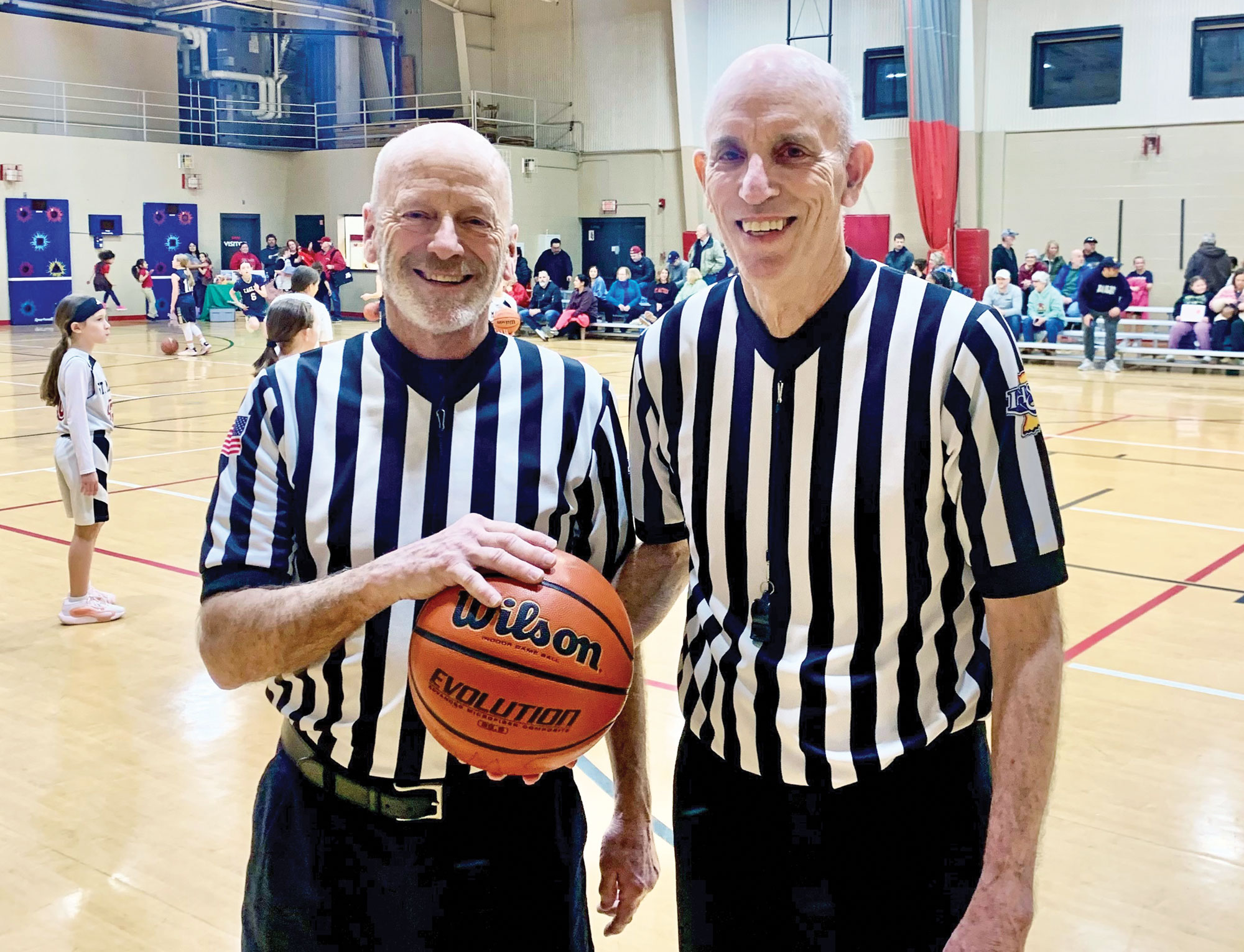
For Bill Wells, right, connections with other officials, players and coaches have led him to continue being a referee for the Catholic Youth Organization for about 25 years. Here, he shares the court with a longtime friend and fellow referee Tim Quigley. (Photo by John Shaughnessy)
By John Shaughnessy
Watching Bill Wells referee a basketball game is a reminder of one of life’s great truths:
There’s more to all of us than what people initially see, even when they see us doing something we love.
And there’s no doubt that the 78-year-old Wells still loves sports and the interaction he has with players, coaches and other officials.
After all, he’s been doing it for 46 years, even after an angry adult player chased him with a baseball bat and another man tried to choke him because they thought he made a bad call.
And for 25 of those years, he has been an official in basketball, football and volleyball for the archdiocese’s Catholic Youth Organization, a dedication that led the CYO to recently honor him as its Official of the Year.
Still, that’s only part of Wells’ story— and maybe not even the most interesting part.
He’s a retired major general in the U.S. Army who served his country for 36 years, service that included jumping from an aircraft 85 times, from an altitude as high as 4,500 feet.
The former runner for Indiana University’s varsity cross country and track teams was also moving on the ground in Saudi Arabia when the U.S. defended that country in 1990-91 after Iraq’s invasion of Kuwait—a tour of duty that nearly killed him and contributed to a 60% disability in his lungs.
There’s also his most humbling Army experience, the one that still makes the retired two-star general well up in emotion and tears years later—the times he led the Army’s honor brigade that offered our country’s respect, heartbreak and pride when the bodies of soldiers who were killed in combat were returned to the United States.
All those experiences—in sports, in service to his country, in life—have their start in his freshman year at Indiana University in Bloomington, including the wild and defining story of how he became a basketball referee against his wishes.
‘Son, you need discipline’
When Wells wanted to attend Indiana University in 1966, his father—a veteran of both the U.S. Army and Air Force—told him he could only go there if he signed up for the Army’s Reserve Officers’ Training Corps (ROTC), a program designed to train and commission military officers while they earn a college degree.
“The bottom line was my dad saying, ‘Son, you need discipline,’ ” Wells recalls.
A touch of that discipline came after he angrily objected to a foul call during an intramural game at IU by firing the basketball through a window of the fitness center.
After getting a technical foul, Wells was told to leave the building. And the next day, he had to meet with the director of intramurals, who gave him a ref’s whistle and said, “Congratulations, Bill, you are no longer a player. You are now a basketball official. Take your whistle. Get on the court. It starts now.”
Sixty years later, Wells is still benefitting from that experience.
“I learned how it was to be an official. It certainly made a difference to me. I’ve been a player, a coach and an official, so I can understand all those perspectives, and that goes with players when they get upset.”
That understanding showed during a recent CYO game when a girl, who didn’t like one of his calls, threw the basketball against a wall. He called her over and talked to her calmly.
“I basically told her, ‘Hey, it’s an emotional game. I understand we all make mistakes. You made a mistake by the way you threw the ball. Let’s settle down. Let’s play basketball.’ She said, ‘Yes, Mr. Official, I’m sorry.’
“Instead of yelling across the court and everyone in the stands knowing what I said, I just talked to her in a normal voice. A lot of that is experience over the years. You understand there are emotions, highs and lows. That’s how far I’ve come from throwing a basketball through a window.”
A memorable jump from a helicopter
Wells also came a long way in the Army after earning a master’s degree in exercise physiology and coaching in 1972.
Recalling his ROTC days, he says, “I was never a leader. I stood in the back of the formation.”
His path to becoming a major general in charge of thousands of soldiers included stepping into the unknown—during the 85 times he jumped from an Army plane or helicopter.
“My big thing in logistics was airdrops—throwing things out of the back of aircraft and jumping out of airplanes,” he says. “I even attended jumpmasters’ school. That’s where you throw your fellow Army men and women out the side or the ramp of a C-130 or a helicopter.”
One particular jump still stands out to him. It’s the story of when he was promoted to captain, a story he shares with a laugh.
“They took us up in a helicopter. I went up as a first lieutenant with a chaplain, a jumpmaster, myself and my commander. I was read my promotion orders in the helicopter. They cut off my lieutenant’s bar and taped on a captain’s bar and threw me out of the aircraft. I went up as a lieutenant and came down as a captain.”
He also shares the serious side of jumping from aircraft.
“We were a parachute rigger unit. I dropped along with my warrant officer and my platoon. We packaged bulldozers and road scrapers for the engineer brigade. You can’t make a mistake in the aircraft. If you make one mistake in the aircraft, you put people in danger.”
Violent acts and powerful thank-you’s
As always in a basketball game, no matter the level of competition, there are coaches and fans who forcefully try to help refs with a call and/or question their eyesight and judgment.
In a recent CYO game between fourth-grade girls, fans and coaches shout at different times, “that’s a foul!”, “that’s a travel!”, “three seconds!” and other assistance.
Wells takes nearly all of it calmly, but when a fan gets too vocal, he shoots him a look that once upon a time must have made a soldier, who did something out of line, quiver in his or her boots.
He also offers this perspective, “I’ve mentored folks who have never been an official before and once they get out there and do a game or two, they come to you and say, ‘Gosh, I thought this would be easy.’ It is easy if you’re sitting in the stands and you think you saw a foul from your angle, but what did the official see from their angle?”
His level of tolerance is high, but his voice is touched with disdain when he recalls the angry adult player who chased him with a baseball bat and another man who tried to choke him.
“In both those situations, players with cooler attitudes came and pulled the guy back,” he notes.
He also has little tolerance for coaches at any level whose team is winning by a huge margin in the fourth quarter and is still using a press defense against an overmatched opponent.
Sportsmanship is important to him, and he sees plenty of it in the coaches and players in CYO sports.
“Something that has always stood out to me is when the winning and losing team come over to fist bump or shake hands with the officials and thank us,” he says. “To some, it may seem like a simple gesture. To me, it shows the athlete’s good sportsmanship and overall great character.”
Wells knows the power of a thank-you, especially from CYO coaches.
“No matter how many times they yelled at you, ‘that’s a foul!’ or ‘that’s a travel!’, they come over at the end of the game and say, ‘Hey, thanks for being here.’
“That’s important, not so much for me as an official, but really it’s important that a young official gets that recognition of people saying thanks. That pumps up young officials—‘that somebody really recognizes me for what I do as an official.’ Without those people in stripes, we couldn’t be out here having a game, whether you agree or disagree on how we call the game.”
‘You were lucky … or you’d be dead’
In the Army, Wells knew danger far beyond an angry player with a baseball bat.
He faced that danger as a result of his service in Saudi Arabia during Operation Desert Storm and Desert Shield in 1990-91.
“We had just chased Sadaam Hussein [the then-president of Iraq whose forces invaded Saudi Arabia] out of Kuwait City,” recalls Wells, who also was involved in operations in Turkey, Syria and the Balkans. “We flew through the burning oil wells. I was on the ground for maybe three days.”
After leaving Saudi Arabia, Wells returned to a daily routine with his staff where they put on their gear and did a run.
“I ran at Indiana University, and there was no one in my unit who could outrun me,” he says. “When I’d run with them, they were struggling usually. As the month went on, I started to have trouble breathing—to the point I couldn’t walk up and down a set of stairs without having to stop and sit down.”
When he checked into a MASH unit (a mobile Army surgery hospital), the medical staff did a CT scan on him. The image of his lungs alarmed everyone.
“A doctor said, ‘See this picture? See all that red? That’s a blood clot that blew up in your lungs. You were lucky it didn’t go to your heart or you’d be dead.’ ”
‘I still push it’
As Wells works his way up and down the basketball court, he does so with a 60% disability to his lungs.
Considering that reality and that he is 78, many people in a similar situation might choose something else to do. Wells has, but his choice is to do more.
He also officiates football, volleyball and softball games. And there’s this choice.
“I still run,” he says. “Running up and down the court when there are fast breaks, it sometimes gives me my speed work. So, there’s health benefits. And I still like to go out and compete as a runner six or seven times a year. I run mostly 10 Ks [6.2 miles]. Even with the bad weather,
I have a treadmill. Every other day, I do 6 to 7 miles to get in shape.
“And I’m competitive, even though I have a disability from the war with my lungs. I still push it. All in all, it’s good stuff.”
There’s also the sense that Wells keeps trying to drain every ounce and every joy of life because of what he saw during his time in the Army—the heartbreak of young lives cut far too short.
‘The most humbling honor I could have done’
That devastating reality takes him back to his days in the Pentagon in Washington when he served in the Army Reserves.
One of his responsibilities included a duty that he is still “most proud of” and “very humbled by,” an experience that even years later makes him well up in tears.
“When we had forces in battle and our soldiers were killed, they flew them back on an aircraft into Dover Air Force Base in Delaware,” Wells says. “Each of the services did their own thing when the aircraft landed. The Army chief of staff said that when any aircraft lands and there are American Army soldiers on there, there will be a flag officer representing and receiving those people. That was my duty, besides my other work.
“I’d get a notice that might say, ‘Tomorrow morning at 2 a.m., there’s an aircraft coming in with 20 to 25 casualties.’ My colonel would go with me, and I’d take the honor guard that also does the Tomb of the Unknown Soldier. We would go up to Dover. I may be there with a Navy admiral or someone from the Marine Corps.
“When the aircraft landed, we had a procedure where we would march out. We’d go up in the aircraft with the chaplain, and he’d say a prayer for the people who had come back. Then they would be ceremoniously taken off the aircraft and placed in a van. And that van would go across the post to the mortuary.”
Wells pauses. His voice grows softer as the emotions set in again.
“It’s very humbling, very emotional. When I speak to people about that, I tear up. Because that’s the most humbling honor I could have done—to receive back those people who gave their lives for our country.”
‘I am forever grateful’
Thoughts of those young men and women sometimes return him to his younger days.
“One of the things I kid about officiating is that it keeps you young,” Wells says. “It keeps you attached to the game you love. Basketball is what I really loved when I was in junior high. Officiating keeps you youthful.
“And there’s the camaraderie you have with the players, no matter if they’re in high school or they’re fourth-graders who are just learning. Sometimes you get to instruct, which I enjoy.”
He also enjoys officiating volleyball matches with his wife Deb, which they have done for 10 years. And there are the bonds he gains from connecting with people, especially through the CYO.
“CYO has given me wonderful, lasting friends with other officials, coaches and CYO staff members,” he says. “I am forever grateful.”
The archdiocese showed its appreciation for him by choosing him as the Edward Tinder Official of the Year, named for a longstanding executive director of the program.
In honoring Wells, current CYO executive director Jack Schmitz said, “Bill, thank you for your many years of service to our country. We also thank you for your passion, love and dedication to CYO for the past 20-plus years. Without a doubt, we all owe the intramural director at IU a huge thank you for forcefully guiding you in the direction of officiating!”
Wells still smiles at the honor and the reference to his start as a ref.
When he is asked what he would tell the intramural director now, 60 years later, Wells shares this thought:
“I would tell him, ‘You gave me the greatest gift I could ever have.’ ” †