Experience of life in Saudi Arabia shapes life, ministry of Sellersburg deacon
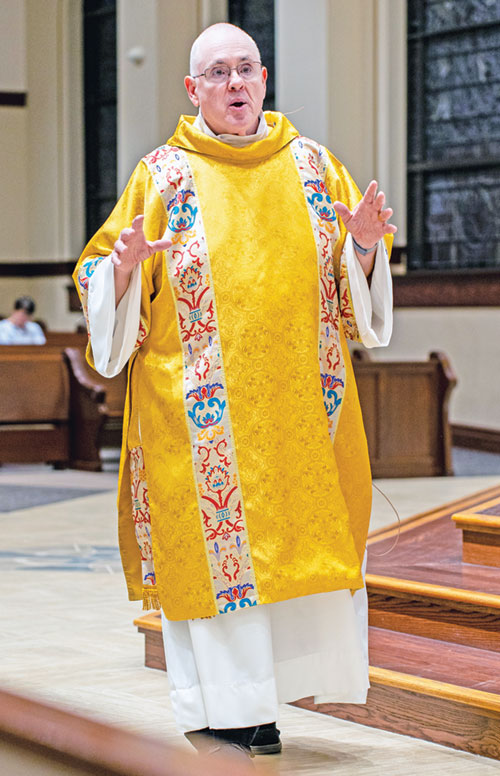
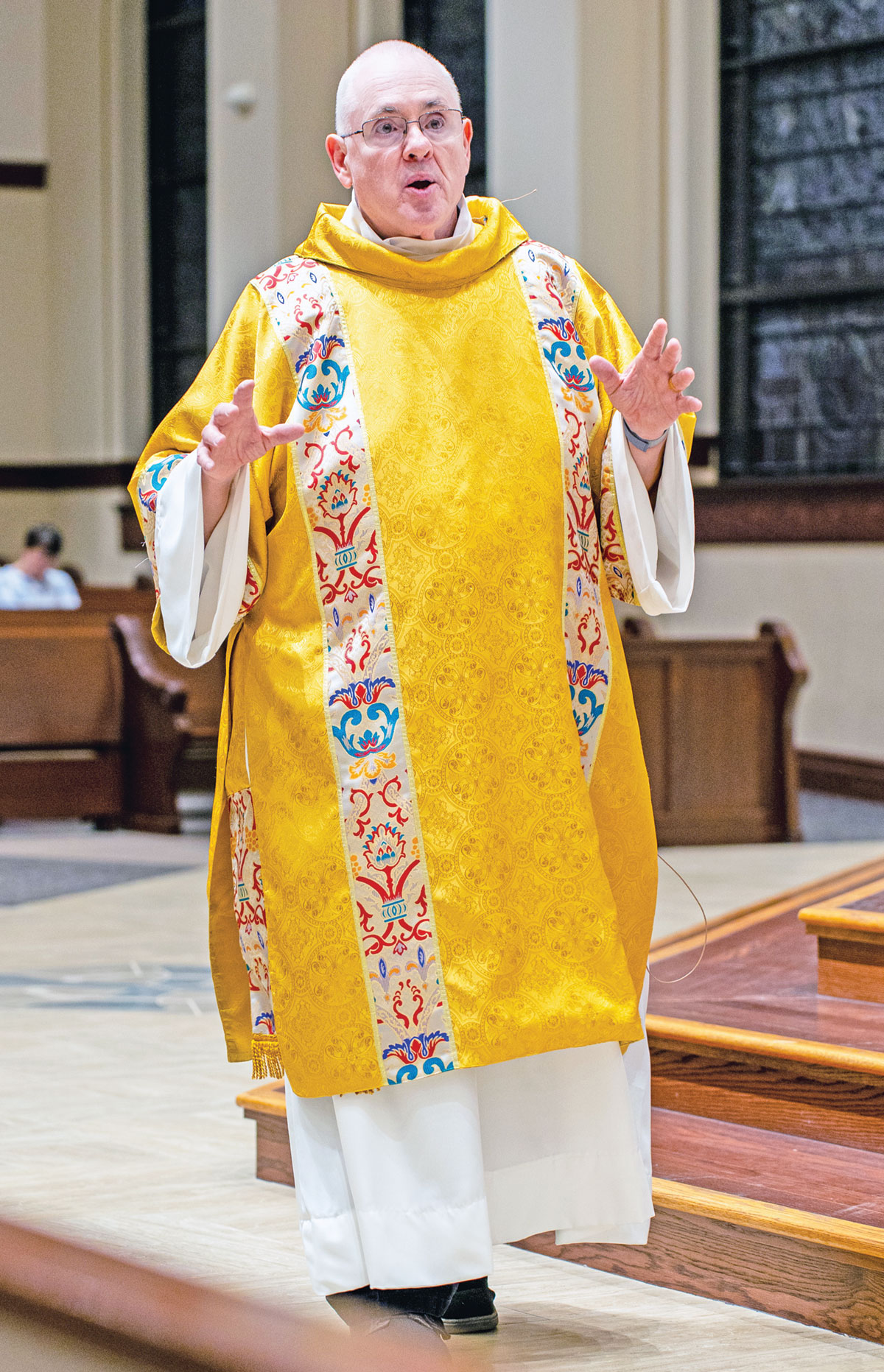
Deacon William Tribbey preaches during an Easter Vigil Mass celebrated on April 4 at St. John Paul II Church in Sellersburg. The challenge of living his Catholic faith in Saudi Arabia some 30 years ago still shapes his approach to ordained life and ministry. (Submitted photo)
By Sean Gallagher
Deacon William Tribbey began ministry at St. John Paul II Parish in Sellersburg at the beginning of Lent earlier this year.
It’s a very different place from where Deacon Tribby and his family lived when he worked from 1995-98 at a government-owned hospital in Riyadh, Saudi Arabia.
St. John Paul II, he said “is a long way from Riyadh.” While the New Albany Deanery faith community has some 1,600 households, his faith community in Riyadh was made up of about 100 people.
They didn’t worship in a beautiful church but in the U.S. embassy compound, since Islam is the state religion in the Arab kingdom. No other faiths are tolerated there.
Although his time in Saudi Arabia ended nearly 30 years ago, Deacon Tribbey’s life there still affects his approach to life and ministry as a deacon.
That approach includes his deep conviction that, despite the great differences between the cultures of the United States and Saudi Arabia, there are still many aspects of humanity that unite the people of the two countries and others around the world.
“Overall, people want to live a happy life with their families,” Deacon Tribbey said. “That’s the way you could characterize the majority of Saudis and really the majority of people anywhere.”
Adjusting to a ‘cultural shift’
Raising a happy family has been the desire of Deacon Tribbey and his wife Martha from the time they married in 1981.
Before that, Deacon Tribbey actively considered a call to the priesthood as a high school student from 1975-79. That included spending two years as a student at the Latin School of Indianapolis, the archdiocese’s high school seminary which closed in 1978.
In college and graduate school, Deacon Tribbey studied mathematics and computer science, ultimately earning a doctorate in the latter field.
It was in the field of computer technology and its use in medical research that led Deacon Tribbey to be hired by the Saudi government to work at the King Faisal Specialist Hospital and Research Center in Riyadh.
Before committing to the job, Deacon Tribbey spent a month working there. In an interview with The Criterion, he recalled talking to wife about his initial stint there.
“I remember telling her, ‘Well honey, it’s a kingdom, but it certainly isn’t the Magic Kingdom,” he said.
Nonetheless, Deacon Tribbey, Martha and their family moved to Saudi Arabia in 1995. At the time, their three children ranged in age from 3 to 10.
As their Catholic faith was key for Deacon Tribbey and his family, they soon became acquainted with how they could practice it in Saudi Arabia.
That required adjusting to the “cultural shift” of life “as a religious minority and a racial minority.”
It meant that they only could meet for worship on Fridays, which is the day on which Muslims gather for communal prayer.
“We had to train the kids not to talk about where we went on Friday mornings, what we did and who we did it with, not to talk about Jesus or God or anything like that with anybody,” Deacon Tribbey said.
Worshipping in an ‘underground Mass’
The limits placed on the small community of Catholics from America living in Riyadh forced them to make the most of the compacted time they had together.
“We would basically do all of Holy Week through Easter all in one morning,” Decon Tribbey said.
Worship was led by priests serving as U.S. military chaplains in Saudi Arabia who would frequently come and go.
“We had to do everything,” Deacon Tribbey recalled. “We had to organize everything ourselves. We had to plan our liturgies. We had to do our sacramental preparation.”
But at least they could gather freely on the grounds of the U.S. embassy. He knew many Filipino Catholics living in Saudi Arabia who weren’t allowed to worship at their country’s embassy. Since the Philippines has a sizable Muslim population, Saudi Arabia put diplomatic pressure on it to not allow non-Muslim worship to happen in its embassy compound in Riyadh.
This led Filipino Catholics to gather for “underground Masses” celebrated in people’s homes by Franciscan priests who covertly ministered there.
Deacon Tribbey and a friend arrived at such a house not knowing in advance that a Mass was happening there.
“There was this immediate sort of struggle between do we stay or do we go,” he said. “Out of solidarity, we decided to stay.”
That was no ordinary choice. All present could have been arrested if discovered by Saudi authorities.
“It’s a weird experience to sit at Mass and wonder if the police are going to come through the front door,” Deacon Tribbey said. “I can’t imagine what that would be like on a regular basis.”
A faith of second chances
The stakes were even higher for Muslims in Saudi Arabia who converted to Christianity. Deacon Tribbey learned about this through the story of Yahya, a young adult Muslim man from Syria living with his parents in Riyadh.
His English teacher was member of Deacon Tribbey’s faith community, and Yahya asked her many times about Christianity. Each time, she told him that such a conversation wasn’t possible.
What drew him to Christianity was the mercy it offered.
“For people that he perceived to be Christian, people would be forgiven,” said Deacon Tribbey with emotion. “They would be given second chances. He said that in his religion that didn’t happen. That’s what hooked him.”
Then Yahya’s devout Muslim parents found his diary in which he had written about his interest in Christianity.
“He got a call from his older brother who said to him not to come home,” Deacon Tribbey said. “ ‘Mother and father found your diary.’ He said that they wanted to kill him.”
A Muslim converting to another faith is a serious crime in Saudi Arabia, punishable by death.
“One of our neighbors met him in a parking lot and picked him up,” Deacon Tribbey remembered. “For about two weeks, Yahya got shuffled around and hidden by people in the community. They were taking a risk in doing that.”
During that time, Yahya’s life changed forever when he embraced the Catholic faith.
“He was baptized and received his first Communion,” Deacon Tribbey said. “Someone in our community baptized him.”
In the kind of life-and-death situation faced by Yahya, lay Catholics can licitly baptize a person according to the Church’s Code of Canon Law.
Deacon Tribbey recalled how he and others in the Catholic community in Riyadh pooled funds to make it possible for the young man to flee to Egypt.
“I can’t believe we actually did that,” said Deacon Tribbey in disbelief even decades later. “It just seems crazy thinking about it.”
‘We would go to church and wouldn’t want to leave’
Life in Saudi Arabia was getting too crazy for Deacon Tribbey and his family to remain there.
He knew that his life could be turned upside down immediately if he was simply accused of sharing his faith or practicing it publicly.
“I would lay in bed at night thinking that it would only take a small thing for one of my Saudi neighbors to point a finger at me,” Deacon Tribbey said. “I could be taken away in the middle of the night, and my wife would have no recourse at all.”
He and his family also experienced what they were missing when they’d come back to the U.S. on vacations.
“We would go to church and wouldn’t want to leave,” Deacon Tribbey remembered. “We just wanted to soak up as much as we could being in a place where there are stained-glass windows, crucifixes and pictures.”
He’d look around at his fellow worshippers in the U.S., realizing how little they grasped the freedom they had.
“There was always this feeling that people at home just did not have an appreciation for what they had,” Deacon Tribbey said, “because, if they really did, they’d be much more fervent about things.”
These considerations, combined with the financial advantages of living there decreasing, led Deacon Tribbey and his family to return to the U.S. after three years in Saudi Arabia.
‘In so many ways, we’re the same’
Looking back nearly 30 years after returning to the U.S., Deacon Tribbey said that his time in Saudi Arabia definitely left a mark on him.
“I can’t say those were the good old days, but they were certainly valuable days,” he said.
Father Thomas Clegg, pastor at St. John Paul II, was a fellow student with Deacon Tribbey at the Latin School. He appreciates his ministry in the Sellersburg faith community.
“Will is very intelligent, but his homilies are very down to Earth,” said Father Clegg. “He’s not really heady.”
He also sees in Deacon Tribbey a good influence and witness of faith for his parishioners because of him also being a Third Order Franciscan.
“He has a simplicity to him that is a healthy example of a Franciscan lifestyle,” Father Clegg said.
The Franciscan spirit has also led Deacon Tribbey to value dialogue and understanding in his relations with other people, an aspect of his life that he said was also shaped by his experience in Saudi Arabia.
“I’ve learned to always try to understand first before making judgments,” Deacon Tribbey said. “Whenever there’s conflict or differences, I always try to dialogue. Can we at least have some sort of conversation about whatever it might be? We need to know people and understand them, at least a little bit. Because, in so many ways, we’re the same.” †