Diversity of Church on display at annual St. Martin de Porres Mass

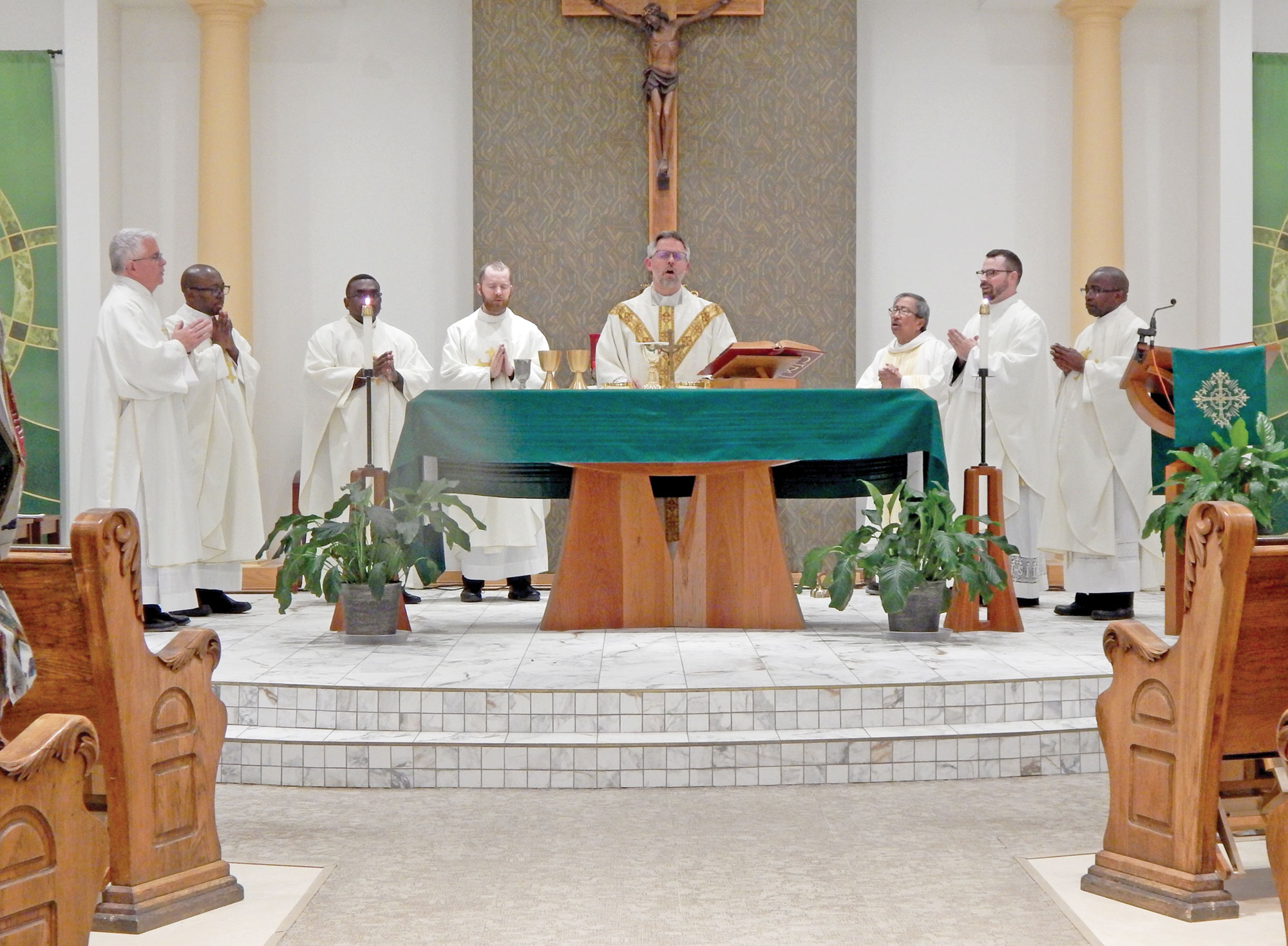
Clergy pray during a Nov. 3 Mass at Holy Angels Church in Indianapolis marking the feast of St. Martin de Porres. (Photo by Mike Krokos)
By Mike Krokos
There were readings in Spanish and English.
And prayers of the faithful offered in English, Igbo, Spanish, Tagolog, Haitian Creole and Swahili.
The voices represented the different cultures of worshippers at the annual St. Martin de Porres Mass held this year on Nov. 3 at Holy Angels Church in Indianapolis, which was sponsored by the archdiocesan Black Catholic Ministry.
Born in Lima, Peru, in 1579, St. Martin de Porres was the illegitimate son of a Spanish knight and a freed African slave. He grew up in poverty and struggled with the stigma of being of mixed race in a time of great prejudice. But he showed great compassion for all people, no matter their race or background.
Martin was abandoned by his father when he was young, and he was rejected by many people in society. After working for a few years as an apprentice to a barber—who also served as a surgeon in those days—he was accepted as a lay helper in the Dominican order. After nine years, the community, impressed with his prayer life, humility and love, invited him to profess vows. While there, he operated their infirmary, where he lovingly cared for the sick and the dying.
“He has such a biracial heritage, so at our Mass today, we tried to incorporate different languages, cultures and people from all the different continents of this Earth,” said Father Benjamin Syberg, parish administrator pro tempore of Holy Angels Parish, who was the principal celebrant at the liturgy. “Martin [offers] such a prophetic vision of what the Church can be in the world today.”
In his homily, Father Syberg referenced Pope Leo XIV’s first apostolic exhortation “Dilexi Te” (“I Have Loved You”) and how the Holy Father focused on the call to love the poor.
“… Has anyone, even at the dawn of the modern era of humanity, so taken up the call of Jesus to radically love the poor? Has anyone ever been so lowly by the estimation of the world, and yet raised to such heights, as Jesus’ most humble servant and his friend, St. Martin de Porres?” Father Syberg asked.
Despite the challenges he faced, the saint “lived only in peace and [an] indomitable trust that God had put him on the Earth exactly where he needed to be. With members of his own congregation often looking down on him with scorn and racism, he won them over with tireless love, knowing that love starts with the unlovable, our brothers at home.”
For St. Martin, that love extended far beyond his Dominican brothers.
“Surrounded by the suffering and the poverty and the illness of the people around him,” Father Syberg continued, “Martin simply accepted as true that whatever he did … for these least ones, he did for Jesus.”
While many in society ignore the poor, Father Syberg said, St. Martin offers a witness of humility and how we are called to love God and neighbor—no matter their state in life.
“Today, as we praise the Lord Jesus who has so loved us, we know that Jesus has given the Church St. Martin as the timely and the providential saint to guide the Church in our day and in our age,” the priest said.
‘I have profound memories’
As a native of Peru, Andres Pecho proclaimed the liturgy’s first reading in Spanish. The member of St. Monica Parish in Indianapolis has a longtime devotion to St. Martin de Porres.
“I have profound memories. I was 15 years old and looking for my way in life. The main church in my town, at the right as you entered it, had a spacious area dedicated to St. Martin de Porres,” Pecho said. “I went there almost every day to pray, asking him to [intercede] for me as I moved forward in my life.”
The life St. Martin lived, Pecho added, continues to provide a great example in discipleship. And some in need still turn to the humble saint in prayer.
“There is still material poverty,” he said. “There are still many people who look to him to intercede before God to help them.”
Irorobeje Crystal Owhoso-Maddox, coordinator of archdiocesan Black Catholic Ministry, said loving God and our neighbor must be at the core of who we are as Christians.
“I think if we did that more often, we’d have a lot more joy in the home, with our neighbors, in our community and in the world,” she said. †